6 min to read
The three entrepreneurial lives of Anji Reddy
How a government-owned pharmaceutical factory helped lay the foundations of Hyderabad's pharmaceutical industry
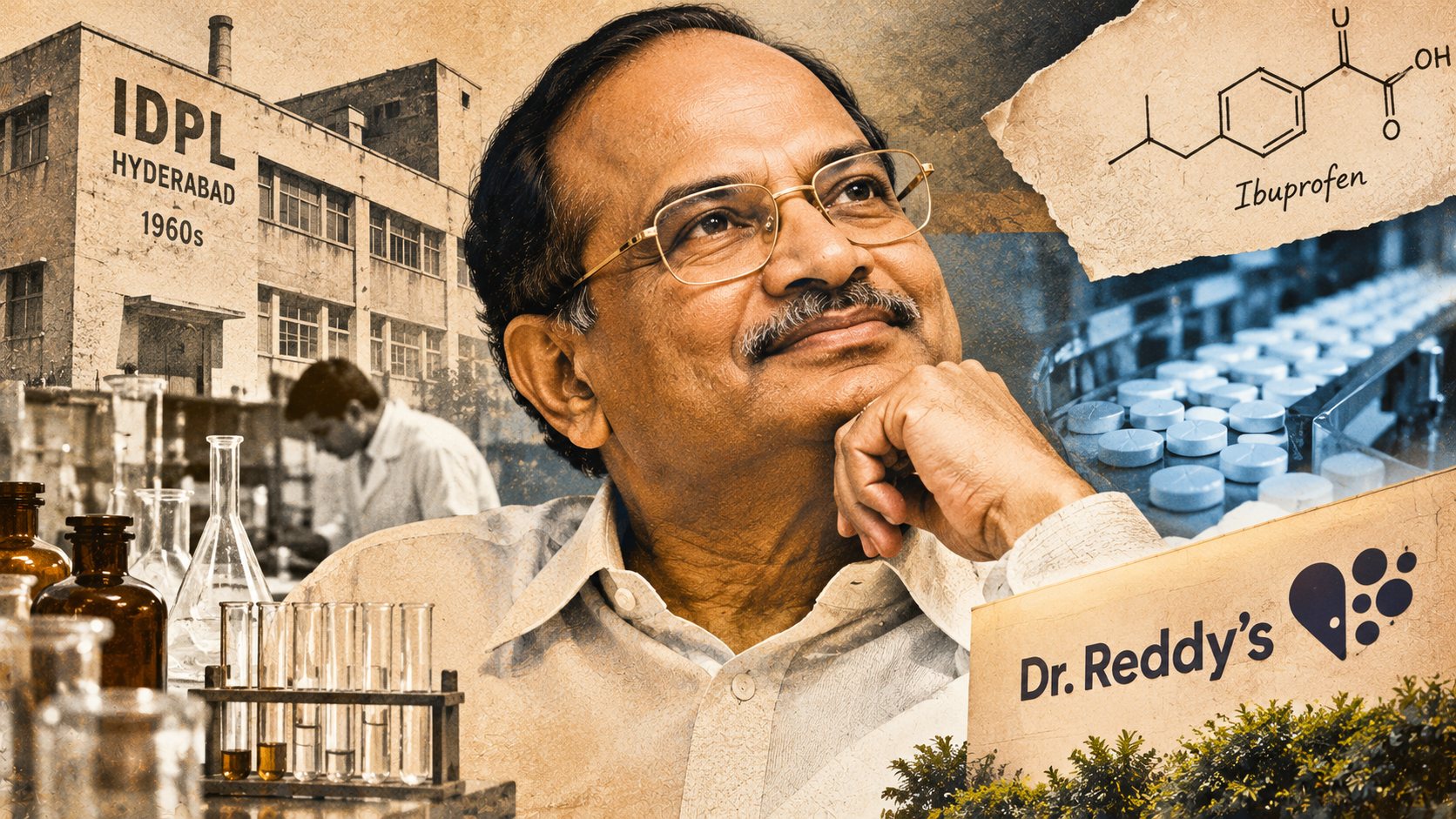
In 1992, while delivering his presidential address at the Indian Pharmaceutical Congress, Dr Kallam Anji Reddy spoke about the possibility of an Indian pharmaceutical company discovering a new drug with an investment of around ₹100 crore. At that time, Western estimates of the cost of developing a new drug ranged between $100 million and $200 million.
His own company, Dr Reddy’s Laboratories, had only recently crossed ₹100 crore in annual sales.
To understand where Reddy derived such confidence, one has to go back to the early years of independent India, when the government was attempting to build a domestic pharmaceutical manufacturing industry with help from the Soviet Union.
The public sector connection
Indian Drugs and Pharmaceuticals Limited (IDPL) was incorporated on 15 April 1961. Three major manufacturing facilities were established under the company. The one at Rishikesh was meant for manufacturing antibiotics, the Madras unit for surgical instruments and the Hyderabad plant for synthetic drugs.
Construction of the Hyderabad plant began in 1964, and by 1967, it had commenced the manufacture of certain drugs. Spread over approximately 336 hectares, the factory had a township of its own. Over the next few decades, it would produce a generation of chemical engineers and pharmaceutical entrepreneurs, one of whom was Anji Reddy.
Reddy came from Tadepalli, a village situated on the banks of the Krishna River, where his father cultivated turmeric. He studied pharmaceutical and fine chemical technology at Bombay University’s Department of Chemical Technology (UDCT), now known as the Institute of Chemical Technology, before obtaining a doctorate in chemical engineering from the National Chemical Laboratory in Pune.
He subsequently joined IDPL in Hyderabad, where he acquired practical experience in the commercial manufacture of bulk drugs.
In those days, much of the Indian pharmaceutical industry was dependent on imported bulk drugs. Indian companies would procure the active pharmaceutical ingredient, convert it into tablets or capsules and sell the finished medicine under their own brand names. Manufacturing the active ingredient itself required considerably greater expertise in chemistry and chemical engineering.
IDPL provided that training.
A World Bank study published around the beginning of this century estimated, based on discussions with local industry representatives, that perhaps one-third of the approximately 200 pharmaceutical companies in and around Hyderabad had been established by people who had earlier worked in IDPL’s production or research departments.
Before Dr Reddy’s Laboratories
Anji Reddy’s first entrepreneurial venture was Uniloids, which he started in partnership with others during the 1970s. Among the products manufactured by the company was metronidazole, a drug used to treat certain bacterial and parasitic infections, which India had previously imported.
In 1980, Reddy established another bulk-drug manufacturing company, Standard Organics. The company became a major producer of sulfamethoxazole, an antibacterial drug widely used in combination with trimethoprim. However, Reddy and his business partner had different ideas about the company’s future diversification.
In 1984, Reddy started his third venture, Dr Reddy’s Laboratories, with an initial investment of ₹25 lakh.
Around the same period, another pharmaceutical enterprise, Cheminor Drugs, became part of his business interests. Associated with Cheminor in its early years was Murali Divi, who would subsequently establish Divi’s Laboratories in 1990.
The opportunities available to these chemical engineers had much to do with a change in Indian patent law.
Under the Patents Act of 1970, India stopped granting product patents for pharmaceutical substances, although the processes used to manufacture them could still be patented. An Indian manufacturer could therefore legally produce a drug patented overseas, provided it developed an alternative manufacturing process that did not infringe an applicable Indian process patent.
A company’s ability to manufacture a molecule economically, with fewer impurities and at an industrial scale, became the basis of competition.
The chemistry of making money
Among the early products selected by Dr Reddy’s Laboratories was methyldopa, a drug used for treating hypertension. Merck was among the international manufacturers of the drug, and its product provided Reddy with a benchmark for quality.
In 1986, following a disruption at Merck’s manufacturing facility in Puerto Rico, Reddy found an opportunity to increase his company’s business in methyldopa. That same year, Dr Reddy’s Laboratories went public.
The company subsequently developed manufacturing capabilities in several other pharmaceutical ingredients, including ibuprofen, norfloxacin and ciprofloxacin.
In his December 2001 profile of Anji Reddy for Business India, journalist Shivanand Kanavi recounted an amusing incident concerning ibuprofen. A foreign buyer had asked Reddy whether his company could match the quality of the product manufactured by Boots, the British company that had originally discovered the drug. Reddy reportedly told him that doing so would require adding impurities to his own product.
The company gradually entered the finished medicines business. In 1991, it introduced Omez, its brand of omeprazole, which went on to become its first pharmaceutical brand to achieve annual sales of ₹100 crore.
The economics of the business was changing. Its expertise in manufacturing bulk drugs now gave the company a cost advantage in selling branded formulations, while the profits from these businesses could be invested in pharmaceutical research.
The unfinished agenda
During the 1990s, Dr Reddy’s Laboratories began investing in the discovery of new pharmaceutical molecules.
It was also around this time that Reddy’s son Satish and son-in-law G.V. Prasad assumed greater operational responsibilities within the group, allowing him to devote more of his time to research.
Diabetes became one of his principal areas of interest. Reddy, himself a diabetic, was particularly interested in compounds that could improve the body’s response to insulin.
In 1997, Denmark’s Novo Nordisk licensed an experimental diabetes compound developed by Dr Reddy’s researchers. Another licensing agreement followed in 1998, while Switzerland’s Novartis entered into a similar arrangement in 2001.
For an Indian pharmaceutical company, licensing its own experimental molecules to international drug manufacturers was an unusual business proposition at the time.
In April 2001, Dr Reddy’s Laboratories listed on the New York Stock Exchange. Its American generics business received a further boost that year when it obtained a 180-day period of generic marketing exclusivity for a dosage of fluoxetine, the antidepressant sold by Eli Lilly under the brand name Prozac.
The drug discovery business, however, proved considerably less predictable. One of the diabetes compounds licensed to Novo Nordisk, ragaglitazar, was withdrawn from development following safety concerns arising from animal studies. Novo Nordisk also discontinued the development of the other compound in 2004.
Reddy continued to pursue pharmaceutical research, a subject that remained close to him until his death in March 2013. His autobiography, published posthumously, was appropriately titled An Unfinished Agenda: My Life in the Pharmaceuticals Industry.
The Hyderabad unit of IDPL, meanwhile, gradually lost its commercial relevance and fell into financial difficulties. Many of the businesses established by its former employees went on to become considerably larger than the parent institution.
Among the less-remembered contributions of India’s industrialisation programme of the 1960s was the creation of such institutions. In the case of Hyderabad, a government factory established with Soviet assistance to reduce the country’s dependence on imported medicines ended up providing the technical manpower for an industry that would earn its revenues by exporting them.