1 min to read
The Making of Mysore Sandal Soap
How wartime sandalwood stocks, a chemist trained in England, and a jewellery-box package made Mysore Sandal Soap an Indian icon.
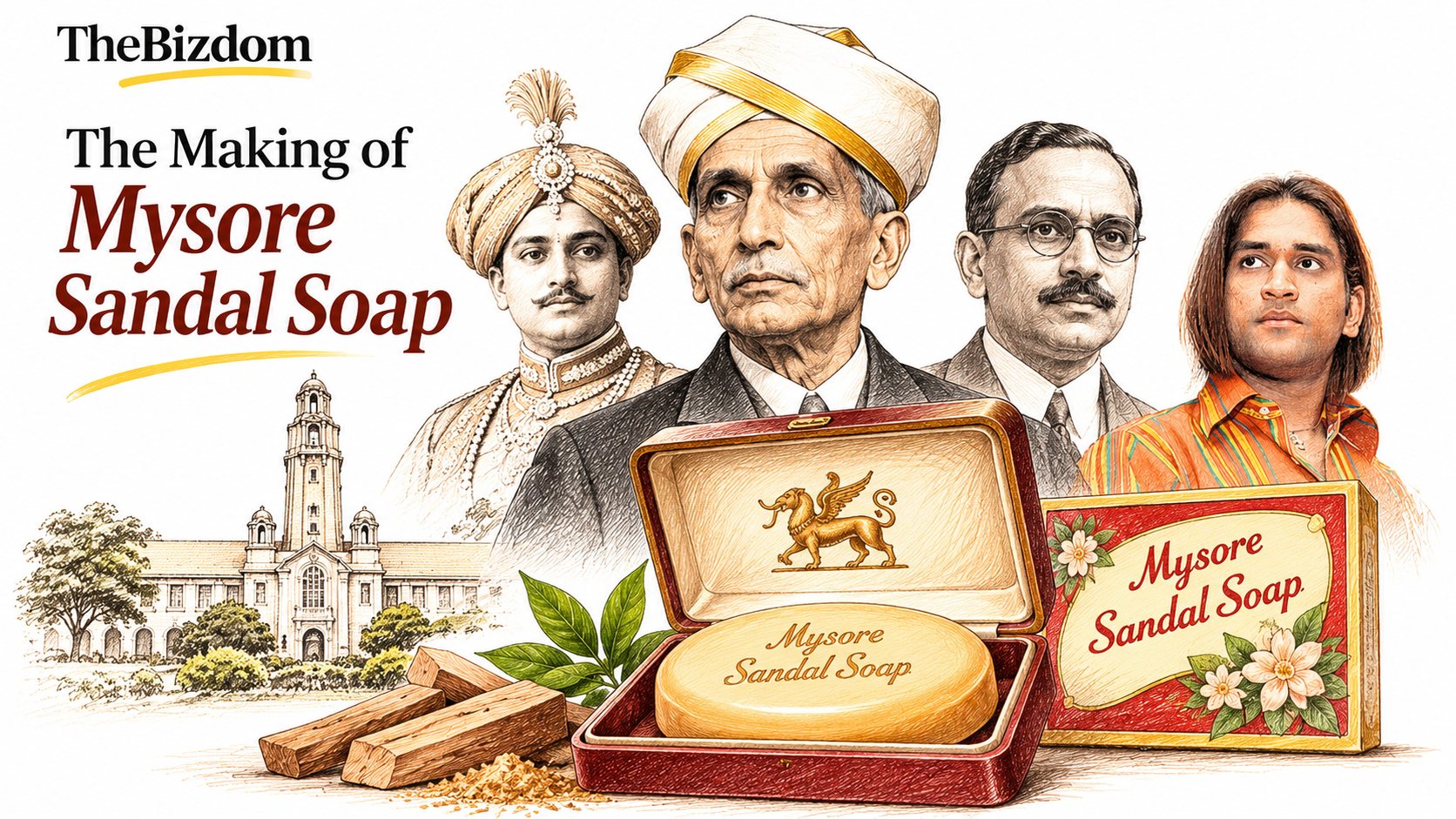
The outbreak of the First World War disrupted sandalwood exports to Europe, leaving the princely state of Mysore with large stocks of the aromatic wood. Maharaja Krishnaraja Wadiyar IV and his Diwan, Sir M. Visvesvaraya, decided to explore its industrial applications.
In 1916, an experimental sandalwood oil extraction factory was established near the Indian Institute of Science (IISc) in Bangalore. A young industrial chemist, Sosale Garalapuri Shastry, was sent to England to learn soap-making techniques. By 1918, Mysore Sandal Soap had entered the market.
Shastry also worked on its packaging. While most soaps in those days were rectangular, he gave his soap an oval shape, wrapped it in fine white paper and placed it inside a box resembling a jewellery case. For its emblem, he chose the Sharabha, a mythical creature with an elephant’s head and a lion’s body.
In 1980, the government soap and sandalwood oil factories were brought together under Karnataka Soaps and Detergents Limited (KSDL).
By 2006, Mysore Sandal Soap was an Rs. 80 crore brand in an Indian soap market estimated at Rs. 4,500 crore. Much of its clientele was over 40 years of age, with a particularly strong following in Tamil Nadu.
To attract younger consumers, KSDL signed a two-year endorsement contract worth Rs. 70 lakh with Mahendra Singh Dhoni in January 2006. However, the association ended prematurely on 20 December 2007, following a dispute over Dhoni’s availability for advertising shoots. The matter subsequently went into arbitration.