6 min to read
Before Essar became Essar
The journey of the Ruia family from the trading houses of Bombay to the ports of India
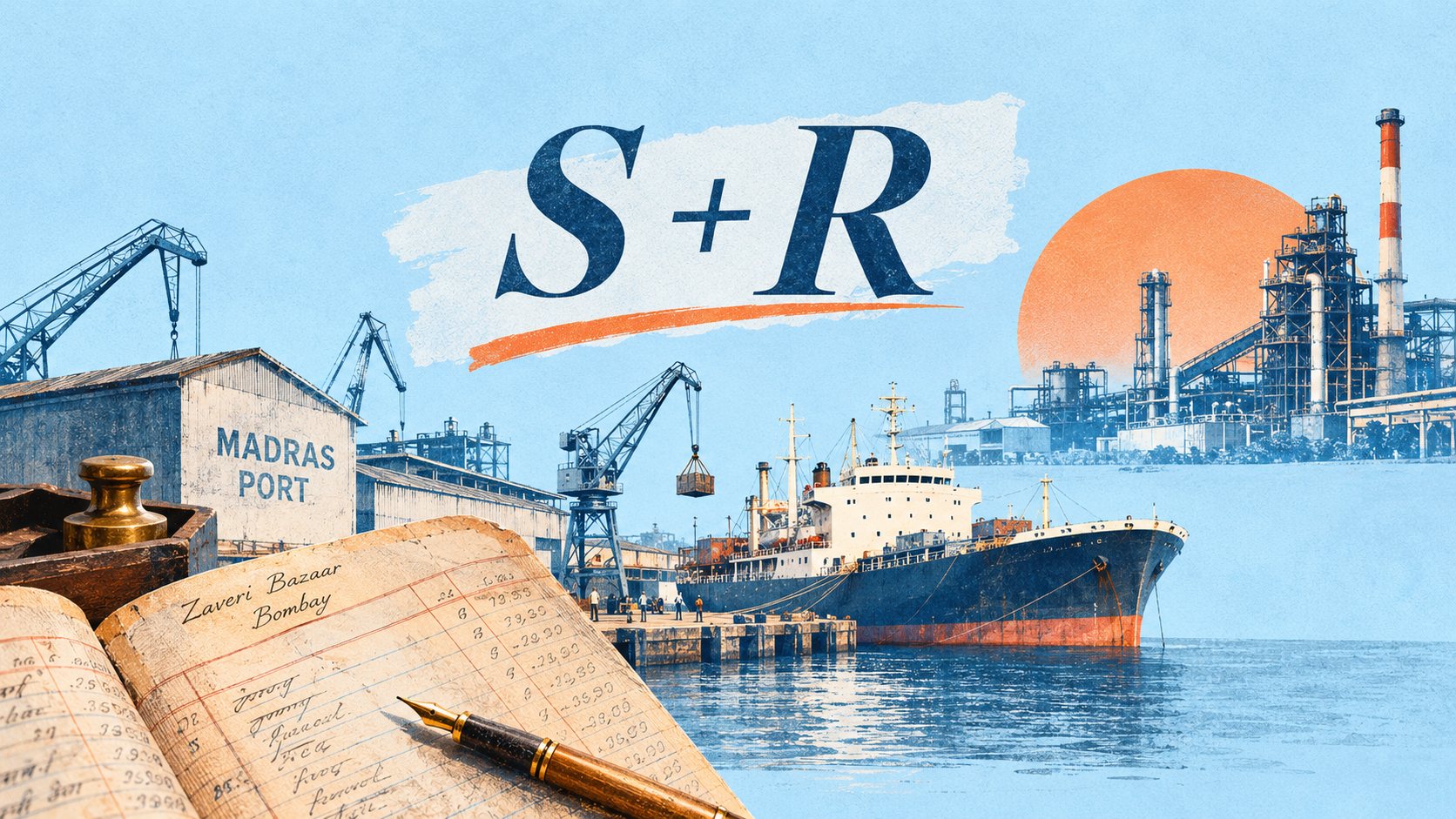
Long before the Ruias became known for their investments in steel, oil and telecommunications, the family belonged to a community of traders from the Shekhawati region of Rajasthan. Like several other Marwari business families of that generation, the Ruias had established themselves in Bombay, where indigenous bankers and commodity merchants operated through a network of family firms.
Shashi Ruia, the elder of the two brothers who would eventually establish the Essar Group, received part of his early business education at the family’s gaddhi in Zaveri Bazaar. The traditional gaddhi, where merchants sat on mattresses surrounded by account books, served as a place of business as well as a training ground for the younger members of mercantile families.
Here, Shashi learnt about commodity trading, credit and the workings of indigenous banking. His subsequent business education, however, would take place among the engineering workshops and docks of southern India.
The Madras years
The Ruia family had business interests in Madras, where Shashi spent a considerable part of his early life. He had intended to study engineering, but the death of his father, Nand Kishore Ruia, brought him into the family business at a relatively young age.
In his 1999 profile of the Essar Group for Business India, journalist Shivanand Kanavi traced Shashi’s entrepreneurial beginnings to his interest in machinery and engineering. Among his early experiments was the development of an air-conditioning system for automobiles, at a time when an air-conditioned car was still something of a novelty in India.
The automobile industry itself was then in its infancy. The import of cars and components was restricted, and Indian entrepreneurs often had to improvise with whatever machinery and technical know-how they could obtain locally.
Shashi’s interests gradually moved towards fabrication and engineering contracts. He was joined in business by his younger brother Ravi, who had studied mechanical engineering.
The name Essar itself has a rather simple origin. It comes from the phonetic rendering of the initials of the two brothers, Shashi and Ravi: S (Ess) and R (Ar).
The business of building ports
In 1969, the brothers entered the marine construction business. One of their earliest major assignments was a contract worth approximately ₹2.5 crore for work at the Madras Port.
India’s industrialisation programme had created a considerable demand for port infrastructure. Petroleum products, machinery and industrial raw materials had to be imported, while commodities such as iron ore were becoming important sources of foreign exchange.
The country’s existing ports required additional berths, deeper channels and mechanised cargo-handling facilities. Much of this work was being undertaken by government organisations, which relied on private engineering contractors for the execution of individual projects.
Marine construction required an understanding of tides, seabed conditions, underwater engineering and the operation of heavy machinery. Contractors also had to invest in specialised equipment that could not easily be deployed elsewhere.
For the Ruias, the acquisition of such equipment and the experience gained from individual contracts gradually opened up opportunities in related businesses, particularly dredging and offshore engineering.
During the 1970s, another development created a new market for Indian engineering companies. The discovery of petroleum at Bombay High in 1974 led the Oil and Natural Gas Commission (ONGC) to develop offshore oil infrastructure along India’s western coast.
There was now a requirement for offshore platforms, pipelines, supply vessels and specialised construction services. Much of the technology and equipment required for these activities had traditionally been procured from overseas. Essar was among the Indian companies that developed capabilities in this area.
From the docks to the ships
The marine construction business brought the Ruias into regular contact with shipping companies, port authorities and the international market for vessels and marine equipment.
Around this time, Goa was emerging as an important centre for India’s iron ore exports. Mining families such as the Dempos, Salgaocars and Chowgules had developed extensive commercial relationships with Japanese steel manufacturers.
The relatively low-grade iron ore available in Goa, which had limited demand among India’s steel producers, found an overseas market. Japan, with its expanding steel industry and dependence on imported raw materials, became an important customer.
A substantial industry grew around the movement of this ore, involving barges, loading facilities, cargo-handling equipment and ocean-going vessels.
The Ruias’ entry into shipping gave Essar another source of income. Unlike an engineering contract, where a company earned its revenue upon completing a particular project, ownership of a vessel allowed it to earn freight income over the operating life of the asset.
It also introduced a different set of commercial risks. Ships were expensive, generally financed through borrowings, while freight rates were subject to international commodity cycles.
Essar Shipping was established in 1983, by which time the group’s interests had expanded well beyond its original construction business.
The Hazira connection
The transition from engineering contractor to industrial manufacturer gathered pace during the 1980s.
The development of natural gas reserves off India’s western coast, particularly the South Bassein field, created opportunities for industries that could use natural gas as a fuel or feedstock.
Hazira, near Surat in Gujarat, became one of the important centres of this industrial development. The availability of natural gas, proximity to the coast and the possibility of importing and exporting bulk commodities made the location particularly attractive for heavy industry.
Essar chose Hazira for its entry into steel manufacturing through a gas-based sponge iron plant. Sponge iron, also known as directly reduced iron, could be produced by removing oxygen from iron ore using natural gas, without having to employ the traditional blast-furnace route dependent on coking coal.
India possessed substantial iron ore reserves but depended on imports for part of its requirement of high-quality coking coal. The gas-based route offered an alternative manufacturing process.
The Hazira plant commenced production in 1990, and Essar subsequently expanded into flat steel manufacturing, power generation and other associated activities.
Fifty years later
The Essar that Shivanand Kanavi wrote about in December 1999 was a very different enterprise from the construction company established by the two brothers thirty years earlier.
The group had entered several capital-intensive industries, including steel, petroleum refining and telecommunications. Financing these businesses had become a challenge of its own, particularly following the economic difficulties of the late 1990s.
Over the following two decades, the Ruias would sell some of the largest businesses they had built. In 2011, Vodafone agreed to acquire Essar’s remaining stake in their Indian telecommunications joint venture for $5 billion.
In 2017, the group completed the sale of its oil refining business, including the Vadinar refinery in Gujarat, to a consortium comprising Russia’s Rosneft, Trafigura and UCP, in a transaction valued at approximately $12.9 billion, including associated infrastructure.
In December 2019, ArcelorMittal and Japan’s Nippon Steel completed the ₹42,000 crore acquisition of Essar Steel under India’s insolvency resolution process.
There is an interesting historical connection in the latter transaction. The Japanese steel industry, which had once provided a market for the iron ore shipped out of India’s western coast, would eventually become part-owner of the steel manufacturing complex that the Ruias had built on the same coast.
In the fifty years since their first major contract at Madras Port, the two brothers had built businesses that attracted some of the largest industrial groups of Britain, Russia and Japan.