7 min to read
The company that IBM left behind
How a company created to maintain IBM's abandoned computers changed the way India travels
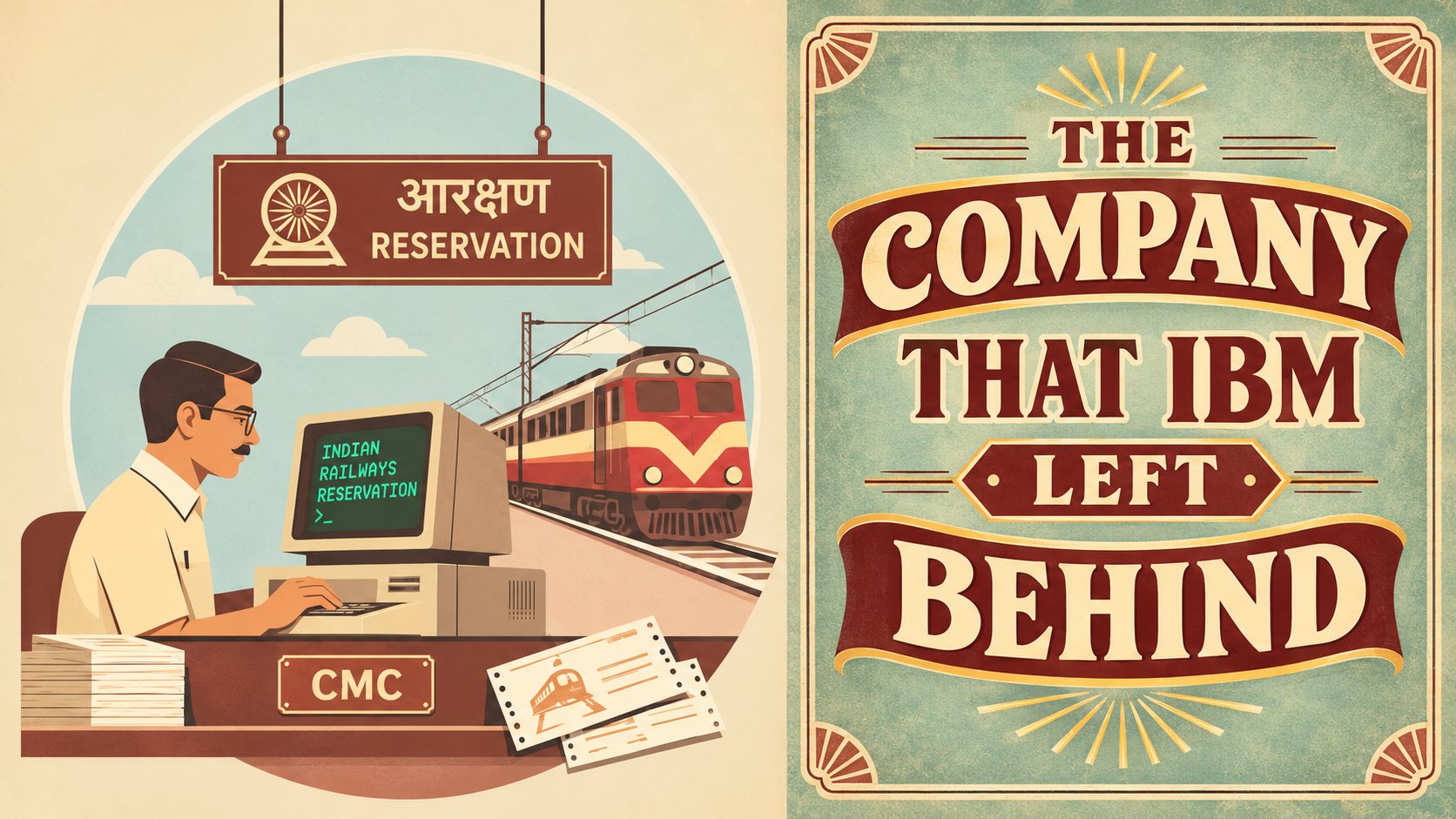
In the 1970s, when IBM decided to wind up its operations in India, the government was faced with a peculiar problem. Hundreds of computers installed by IBM across the country would require regular maintenance, spare parts and the services of trained engineers. Among the users of these computers were government departments, banks, industrial enterprises and the Indian Railways.
The company that eventually took over the maintenance of these machines would go on to undertake some of the most ambitious computerisation projects in independent India.
One of its creations would change the way ordinary Indians travelled.
The IBM connection
IBM had been operating in India since the early 1950s. Much of the early computerisation in the country involved its mainframe computers, including the IBM 1401, a machine introduced internationally in 1959. The company also employed Indian engineers who were trained in the installation and maintenance of these machines.
The Foreign Exchange Regulation Act (FERA) of 1973 placed restrictions on foreign ownership of companies operating in India. Following the formation of the Janata Party government in 1977, IBM came under pressure to restructure its Indian operations. The American company eventually decided to leave the country.
Meanwhile, on 26 December 1975, the Government of India had incorporated a company called Computer Maintenance Corporation Private Limited (CMC).
When IBM ceased operations in India in 1978, CMC assumed responsibility for its computer installations at more than 800 locations across the country. Several former IBM employees also joined CMC, bringing with them considerable experience in servicing large computer systems.
Over the next few years, CMC extended its maintenance services to computers manufactured by other international companies. By the beginning of the 1980s, it had started moving into software development and systems engineering.
Among the government institutions where CMC would find an opportunity to demonstrate its newly acquired capabilities was the Indian Railways.
The railway reservation counter
The Railways had been using computers since the late 1960s, when IBM 1401 machines were installed across its nine railway zones, three production units and the Railway Board. They were primarily used for accounting, inventory management and processing operational statistics.
For passengers, however, the experience of buying a railway ticket had remained largely unchanged.
Railway reservation offices maintained elaborate handwritten records of the accommodation available on individual trains. Seats and berths were allocated among different stations, and a reservation clerk had access only to a limited portion of this inventory. Obtaining accommodation from another station’s quota could involve communication by telephone or telegram.
Passengers travelling to different destinations would often have to stand in separate queues.
In a conversation with journalist Shivanand Kanavi in 2011, Sam Pitroda recalled how he and Rajiv Gandhi had been looking for an application of computer technology whose benefits would be visible to a large section of the Indian population. Railway reservations offered one such opportunity.
The proposal encountered considerable resistance from railway employees and their unions. Computerisation in those days was widely associated with the loss of jobs, a particularly sensitive issue in a country with high unemployment.
During discussions with the unions, an unlikely argument in favour of computerisation emerged. Computers of that generation required air-conditioned rooms. The introduction of computers would therefore also mean air-conditioned working environments for reservation clerks.
A pilot project was agreed upon, and the responsibility for demonstrating the feasibility of the system was given to CMC, then headed by Dr P.P. Gupta.
Project IMPRESS
On 15 November 1985, the pilot project for computerised passenger reservations was launched in New Delhi. Developed jointly by CMC and the Indian Railways, the software was called IMPRESS (Integrated Multiple Train Passenger Reservation System).
The system had to accommodate the numerous peculiarities of Indian railway travel. A berth could be occupied by different passengers during different portions of a train’s journey. There were different classes of travel, reservation quotas, concessions, cancellations and waiting lists. The allocation of accommodation had to take all these variables into account.
For the Railways, computerisation also simplified the preparation of passenger charts and the accounting of reservation revenue. For the passenger, it meant that a single reservation counter could handle bookings for several trains.
During the latter half of the 1980s, the system was extended to Bombay, Calcutta, Madras and Secunderabad.
In 1986, the Railways established a separate organisation called the Centre for Railway Information Systems (CRIS), which was entrusted with the development of computer applications for various railway operations.
CRIS subsequently developed a new reservation system called CONCERT (Countrywide Network for Computerised Enhanced Reservation and Ticketing). First introduced in Secunderabad in September 1994, the system was gradually extended to the other reservation centres.
By 1999, the five regional reservation systems had been interconnected, allowing passengers to book accommodation on trains running in different parts of the country.
When railway tickets came by courier
In September 2003, Shivanand Kanavi wrote an article for Business India on a relatively new entrant in the Indian e-commerce business, the Indian Railway Catering and Tourism Corporation (IRCTC).
Established in 1999, IRCTC had originally been created to manage the catering, hospitality and tourism-related activities of the Railways. It entered the online ticketing business in August 2002.
On its first day of internet ticketing, IRCTC sold just 29 tickets.
There was one limitation to its business model. Although customers could purchase tickets over the internet using their credit cards, the actual railway ticket had to be physically delivered to their homes. IRCTC’s geographical expansion was therefore dependent on the availability of courier services.
Among the early markets for its services were several relatively small towns in Kerala. Kanavi also found that a substantial portion of IRCTC’s customers were over the age of 30, at a time when internet commerce was generally regarded as something meant for the younger generation.
By September 2003, IRCTC was handling more than 50,000 bookings every month. During its first year, the value of tickets sold through its website had reached approximately ₹57 crore.
In 2005, the Railways introduced electronic ticketing, allowing passengers to print their reservation slips at home. Subsequently, even the requirement of carrying a printout was dispensed with, as passengers could produce the reservation message received on their mobile phones.
By 2019, IRCTC had become a publicly listed company.
Whatever happened to CMC?
In October 2001, as part of the government’s disinvestment programme, Tata Sons acquired a controlling stake of 51 per cent in CMC for ₹152 crore. Three years later, the government sold its remaining stake, while Tata Sons transferred its shareholding to Tata Consultancy Services (TCS).
By then, CMC had developed a fairly diverse business, undertaking computerisation projects in areas such as transport, banking, industrial operations and government administration.
One of its assignments, announced in December 2001, was a ₹23.57 crore contract for processing 22.8 crore census forms for the Registrar General of India.
In 2015, nearly forty years after its incorporation, CMC was amalgamated with TCS. Its shareholders received 79 shares of TCS for every 100 shares they held in CMC.
There is another interesting connection here. TCS and CMC had both developed their early computer engineering capabilities during a period when India had considerable restrictions on the import of computer hardware and access to foreign exchange.
Today, they are part of the same enterprise.
September 2020
In February this year, the Ministry of Railways informed Parliament that more than 70 per cent of its reserved tickets were being booked through IRCTC’s website.
The Covid-19 pandemic has made computerised reservations even more important. As passenger services are being gradually restored after the national lockdown, the Railways have been operating special trains with advance reservations. On 12 September, another batch of such trains commenced operations.
The Railways are also experimenting with contactless ticket verification using QR codes.
Nearly thirty-five years have passed since the first computerised railway reservation project was launched in New Delhi. At the time, its proponents had to persuade railway employees that computers could improve their working conditions and convince the public that computerisation had practical benefits.
CMC, the company created to maintain computers abandoned by an American multinational, no longer exists as an independent corporate entity. But the railway reservation system, whose development it helped initiate, remains perhaps one of the most widely used applications of computer technology in India.