4 min to read
The Making of India's Ceramic Industry
The story of Morbi, the Somany family and how Indian companies built a market for branded tiles.
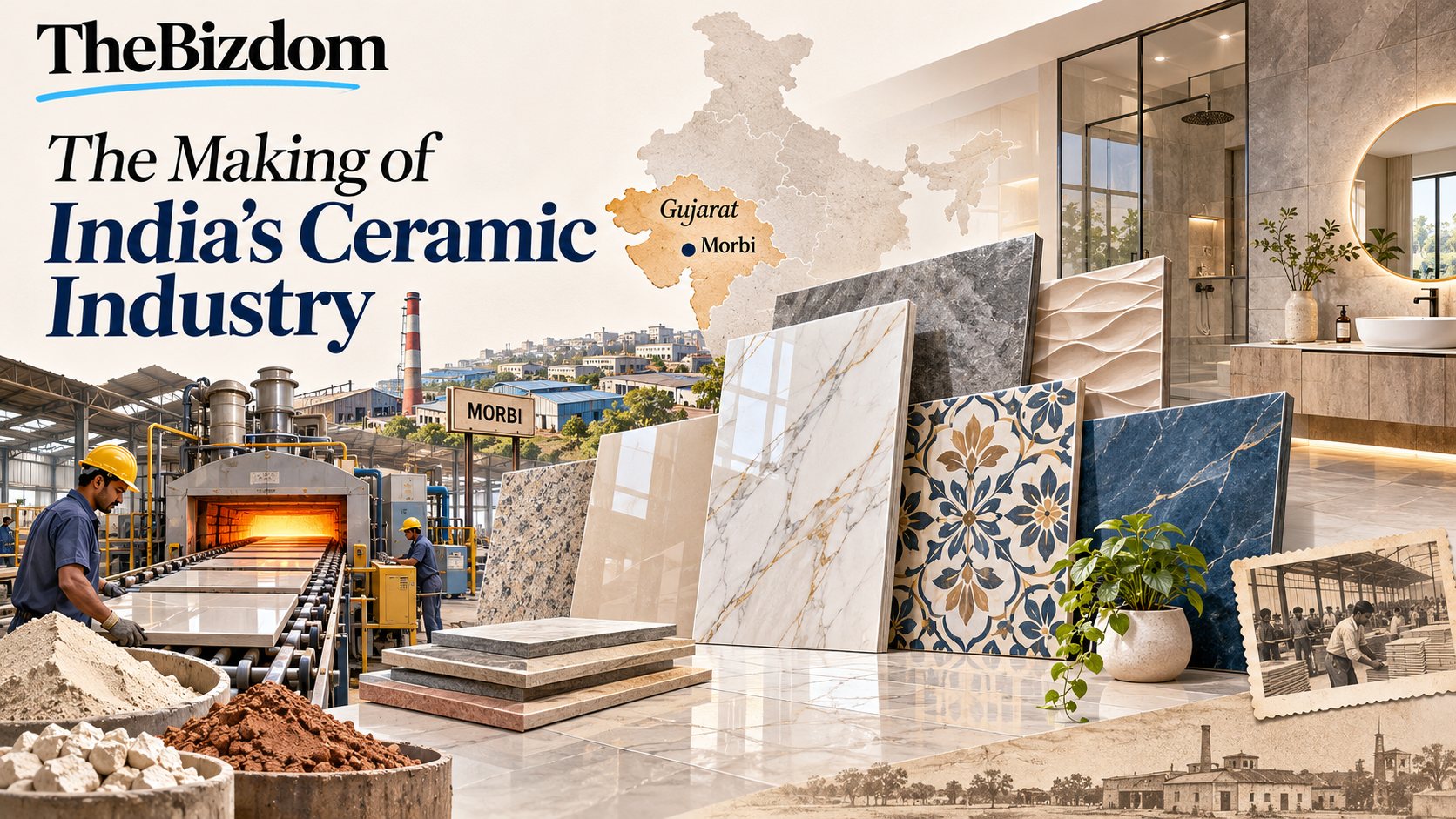
In 1926, a businessman from Maharashtra, Parshuram Kanpule, moved to the princely state of Morbi in Gujarat and established a factory for manufacturing roofing tiles. Over the years, his business, Parshuram Potteries, diversified into stoneware pipes, sanitaryware, glazed tiles and refractories.
The availability of suitable clay in the region had traditionally supported pottery and the manufacture of earthen roof tiles. Much of the modern ceramic industry of Morbi would subsequently develop around these manufacturing activities.
Nearly a hundred years later, India has become the world’s second-largest producer and consumer of ceramic tiles after China, and much of the country’s tile production takes place in and around this small town in Saurashtra.
The Somany connection
The origins of one of India’s largest tile companies go back to Calcutta. In January 1968, Hira Lal Somany established Somany Pilkington’s Ltd. in collaboration with Britain’s Pilkington Tile Holdings.
Under the arrangement, the British company received part of its equity holding in exchange for supplying machinery and equipment. The Industrial Credit and Investment Corporation of India (ICICI) was amongst the initial shareholders.
The first manufacturing facility was established at Kassar in Haryana in 1971, with an annual production capacity of just 520,000 square metres. A second factory was established in 1983 at Kadi, near Ahmedabad, to cater to the growing demand in western and southern India.
In 1994, the Somany family acquired the British partner’s shareholding, and the company was subsequently renamed SPL Ltd. In 2007, it adopted its present name, Somany Ceramics, and entered the sanitaryware business.
Today, Somany has a combined annual manufacturing capacity of around 62 million square metres, with access to additional capacity through manufacturing arrangements with other companies. Its products are sold under several collections, including Duragres and Somany French Collection.
From edible oil to sanitaryware
Incidentally, another businessman with the Somany surname had entered the ceramics industry through a rather different route.
Vikram Somany’s family business, Madhusudan Industries, established in 1945, was engaged in edible oils. In 1980, following difficulties in expanding the oil business, he established a sanitaryware manufacturing unit at Kadi, with an initial annual capacity of three lakh pieces.
The ceramics division was separated from Madhusudan Industries in 2001, and Cera Sanitaryware was listed on the Bombay Stock Exchange in May 2002.
Cera subsequently entered the bathroom fittings business, establishing its own faucet manufacturing facility in 2010–11. Its entry into tiles came much later, through an investment in Anjani Tiles in Andhra Pradesh in 2015–16, followed by an investment in a Morbi-based tile manufacturer.
Unlike Kajaria and Somany Ceramics, whose businesses are predominantly centred around tiles, Cera derives much of its revenue from sanitaryware and faucets. The addition of tiles, kitchen sinks and other bathroom accessories allows its dealers to sell a wider range of products to the same household.
The Spanish connection of Kajaria
Ashok Kajaria was involved in his family’s trading business when, during a business trip to the Gulf, some of his customers suggested that he visit Spain to explore the manufacture of ceramic tiles.
Kajaria subsequently entered into a technical collaboration with Todagres, a Spanish tile manufacturer. Kajaria Ceramics was incorporated in December 1985, and commercial production began in August 1988 at Sikandrabad in Uttar Pradesh, with an annual capacity of one million square metres.
One of Kajaria’s early successes came from introducing larger-sized tiles into the Indian market. By 1995, the company had crossed a turnover of Rs. 100 crore.
Over the next two decades, the Indian consumer gradually moved towards vitrified tiles, which have lower water absorption and greater resistance to staining. Digital printing subsequently made it possible to reproduce the appearance of marble, granite and even wood on ceramic surfaces.
Kajaria expanded into Rajasthan in 1998 and subsequently acquired interests in manufacturing facilities in Gujarat and Andhra Pradesh.
As of September 2024, Kajaria had an annual manufacturing capacity of 93.1 million square metres, including its recently established manufacturing facility in Nepal. It has also diversified into bathroom products under Kerovit and plywood under KajariaPLY.
The economics of Morbi
Much of the expansion of India’s tile industry over the past three decades has happened outside the large listed companies.
Morbi developed a network of relatively small, family-owned manufacturing units, supported by suppliers of clay, glazing materials, machinery and packaging. Several national brands subsequently entered into partnerships with these manufacturers, giving them access to additional production capacity without having to establish entirely new factories.
As per Kajaria’s August 2024 corporate presentation, India’s tile industry was estimated at Rs. 62,000 crore in FY2024, of which exports accounted for around Rs. 20,000 crore.
However, the current financial year has brought some difficulties for exporters. The slowdown in European housing markets, higher freight costs following the Red Sea crisis and the possibility of American anti-dumping duties have affected overseas demand.
A further complication for Morbi’s manufacturers is the price of natural gas. Ceramic kilns operate at extremely high temperatures, making fuel one of the major components of manufacturing costs.
A century ago, Parshuram Kanpule was manufacturing clay tiles for Indian rooftops. Today, the economics of the industry he helped establish in Morbi are increasingly determined by international gas prices, freight rates and the fortunes of the American and European housing markets.