6 min to read
The Steel Company Gandhi Helped Save
The story of Mukand and a business partnership between the Bajaj and Shah families that has lasted for over eight decades.
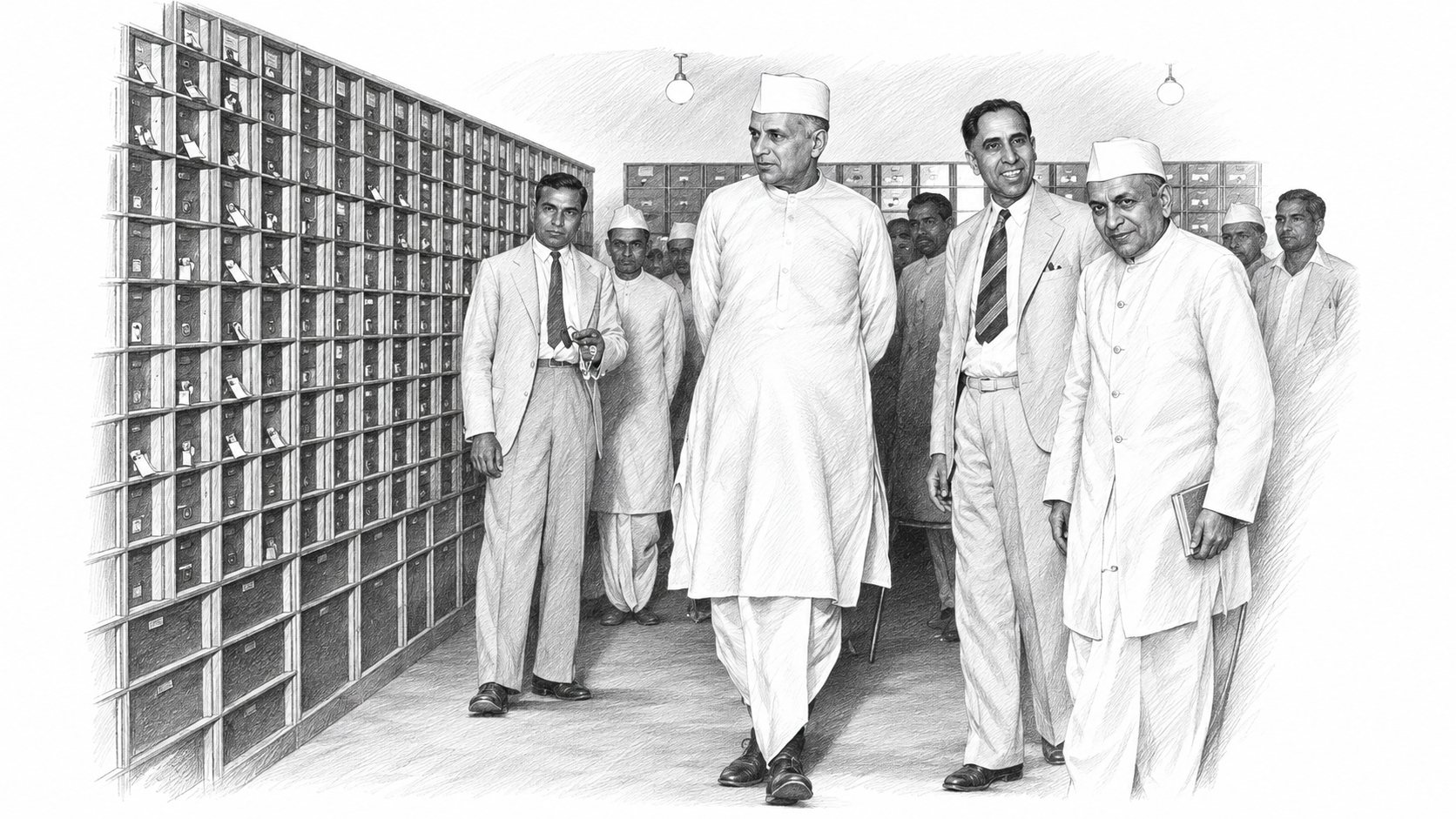
In 1939, a businessman from Lahore, Lala Mukand Lal, approached Mahatma Gandhi with a business problem. His company, Mukand Iron & Steel Works, which had manufacturing facilities in Lahore and Bombay, was in financial difficulty, and he wanted to sell the business.
Gandhi persuaded Jamnalal Bajaj, whom he regarded as his fifth son, and another Gandhian industrialist, Jeewanlal Motichand Shah, to take over the company.
Many years later, while recalling the origins of Mukand, Niraj Bajaj, the grandson of Jamnalal Bajaj, remarked that there was little by way of due diligence in the transaction. Gandhi had asked the two businessmen to buy the company, and that was sufficient for them.
The original Mukand
Born on 5 January 1885 at Radaur, in present-day Haryana’s Yamunanagar district, Mukand Lal came from a family of modest means and received no formal schooling. His search for commercial opportunities took him to Kota and Karachi before he eventually settled in Lahore, where he worked as a civil contractor and later became an iron and steel merchant.
Around 1929, he established Mukand Steel Works in Lahore. According to the Mukand family’s account, it housed northern India’s first steel furnace. Incidentally, the furnace was inaugurated by Kasturba Gandhi, who was visiting Lahore in connection with the annual session of the Indian National Congress.
Mukand Lal was an ardent follower of Gandhi. He wore khadi, spun the charkha daily and had established an ashram for destitute women in his native Radaur, which was subsequently handed over to the Kasturba Trust.
In 1936–37, he also established Delhi Iron & Steel Company at Ghaziabad. Meanwhile, Mukand Iron & Steel Works Ltd. was incorporated in Bombay on 29 November 1937, bringing together his rolling mills and foundry businesses in Lahore and Hindustan Iron & Steel Products Ltd. in Bombay.
Within two years, the management of the business would pass into the hands of the Bajaj and Shah families.
The two Gandhians
Born in 1889 in Kashi Ka Bas, a village in Rajasthan’s Sikar region, Jamnalal was adopted at the age of five by Seth Bachhraj Bajaj, a wealthy merchant based in Wardha. The family’s commercial interests were largely centred around cotton trading, ginning and pressing.
Jamnalal came in contact with Gandhi in 1915 and became closely associated with his political and social activities. He surrendered the title of Rai Bahadur conferred upon him by the British and participated in the Non-Cooperation Movement.
Meanwhile, his business interests had expanded beyond cotton. In 1931, he entered the sugar industry through Hindusthan Sugar Mills, which subsequently became Bajaj Hindusthan.
His association with Jeewanlal Shah brought the two families together in the steel business. Jamnalal died in February 1942, barely three years after acquiring Mukand. Within another five years, one of the company’s factories would find itself located in another country.
A factory lost to Partition
Following Partition in 1947, the government of West Punjab in Pakistan requisitioned Mukand’s Lahore factory.
Under an unusual arrangement, Mukand received shares in Batala Engineering Company (BECO), located in the Gurdaspur district of Indian Punjab, in exchange for its Lahore factory. BECO became a subsidiary of Mukand.
The original founder’s family, meanwhile, relocated to Ghaziabad, where Mukand Lal had established his other steel business before Independence.
Much of Mukand’s subsequent industrial expansion would take place around Bombay, initially at Kurla and later at Kalwe, near Thane.
Making better steel
During the 1950s, much of the discussion around India’s steel industry revolved around the setting up of large integrated steel plants at Bhilai, Rourkela and Durgapur. There was another segment of the industry that received relatively less attention: the manufacture of specialised grades of steel required by engineering companies.
Mukand developed its capabilities in this area under Viren Shah, the son of Jeewanlal Shah.
One of the technologies that was changing the economics of steel manufacturing was continuous casting. Traditionally, molten steel was poured into individual moulds to produce ingots, which subsequently underwent several operations before they could be rolled into useful products.
Continuous casting allowed molten steel to be converted directly into long, semi-finished sections, reducing material wastage and eliminating some intermediate manufacturing operations.
In his July 1994 article for Business India, Shivanand Kanavi identified Mukand as an early adopter of continuous casting technology.
Mukand also worked on improving the quality of steel used by the fastener industry. The manufacture of nuts and bolts involves considerable deformation of steel at room temperature, a process known as cold heading. Even small defects in the original wire rod could result in cracks during manufacturing.
The expansion of the Indian automobile industry in the 1980s and 1990s provided Mukand with a much larger market for such specialised steel products.
The industrialist who entered Parliament
Viren Shah had another career running alongside his industrial one. Born in Calcutta in 1926, he was associated with the Junagadh Rajya Prajamandal during the years preceding the accession of Junagadh to India.
In 1967, he was elected to the Lok Sabha from Junagadh. He subsequently served two terms in the Rajya Sabha and was imprisoned during the Emergency.
Shah took over as chairman and managing director of Mukand in 1972. In December 1999, after 27 years at the helm, he left the chairmanship to become the Governor of West Bengal.
Another member of Mukand’s management, Niraj Bajaj, had distinguished himself in an entirely different field. Before becoming a full-time industrialist, he was a national table tennis champion and represented India internationally.
The Kalyani and Japanese connections
By the mid-1990s, the rising cost of electricity and steel scrap was making Mukand’s electric furnace operations increasingly uncompetitive. The company decided to establish an alternative source of steel using iron ore.
In 1998, Mukand entered into an arrangement with the Kalyani group for a Rs. 500 crore steel project at Ginigera, near Hospet in Karnataka, with an annual capacity of three lakh tonnes.
The manufacturing operations were divided amongst the partners: Kalyani Ferrous would undertake ironmaking, Mukand would convert the iron into steel, while Kalyani Steels would undertake rolling operations.
Another partnership came in 2012, when Mukand and Japan’s Sumitomo Corporation established a joint venture for processing specialised steel products. In 2017, Sumitomo agreed to acquire a 49% interest in Mukand’s alloy steel rolling business, valuing the enterprise at Rs. 2,820 crore.
The Japanese trading house was looking to cater to the growing number of automobile manufacturers in India, particularly those seeking to procure more of their components locally.
The other legacy of Mukand Lal
While the Bajaj and Shah families expanded the steel business, Lala Mukand Lal devoted much of his later life to the development of the region where he was born.
In the mid-1940s, he established a school at Abdullapur (now Yamunanagar) and a maternity hospital at Radaur. He also established a cinema hall at Yamunanagar, the proceeds from which were earmarked for education and social welfare.
Following his death in 1952, his son Seth Jai Parkash continued these activities.
Today, the Mukand name has two distinct associations. For the automobile and engineering industries, it is a manufacturer of speciality steel. For many families in Haryana and western Uttar Pradesh, the same name is associated with schools, colleges and hospitals established by the original founder’s family.