1 min to read
The curious history of the one-rupee note
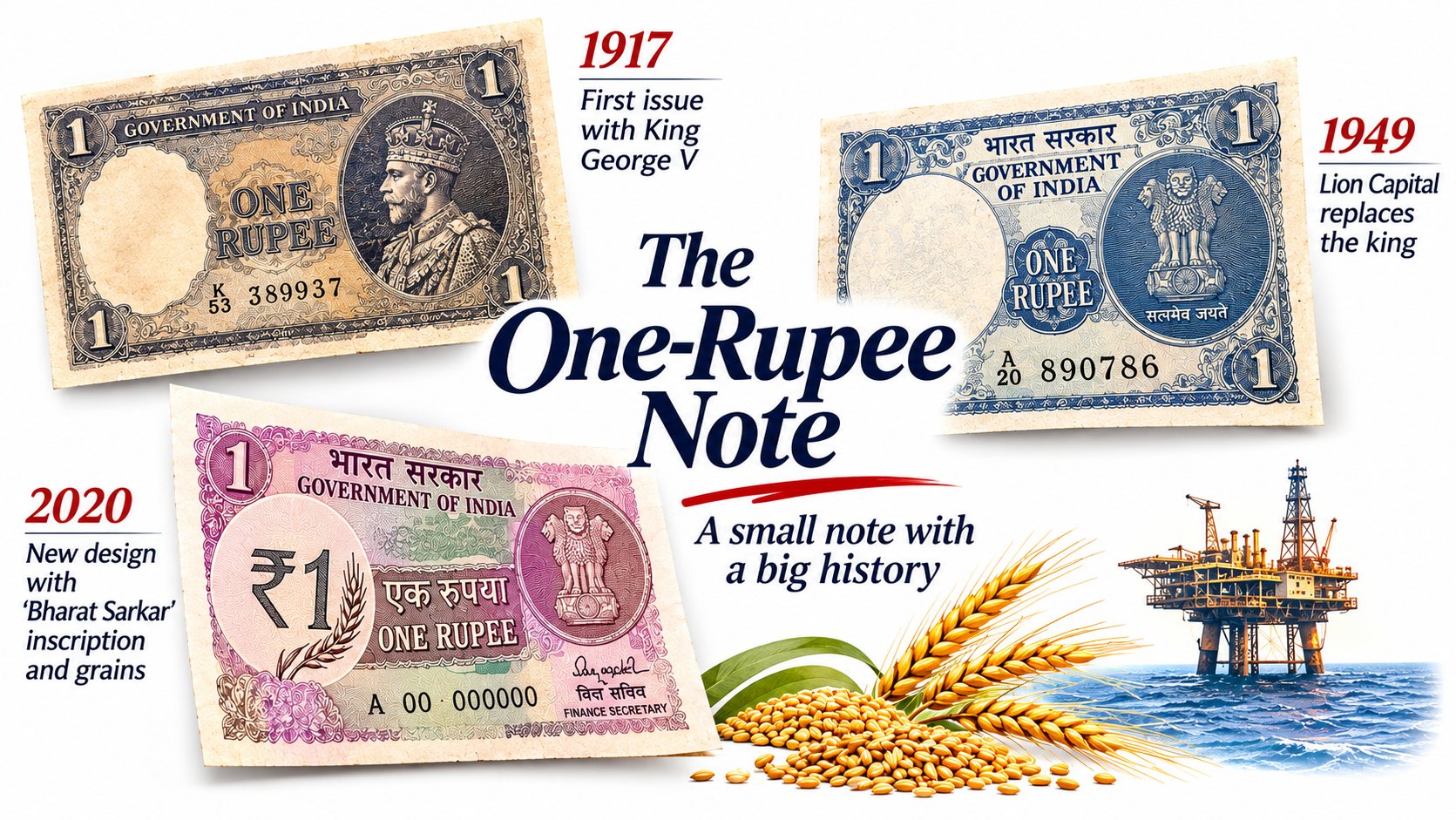
On 30 November 1917, the British Indian government introduced the one-rupee currency note carrying the portrait of King George V. The First World War had disrupted the supply of silver, making the production of silver rupee coins increasingly difficult. The government also introduced another rather unusual denomination, a note valued at two rupees and eight annas.
The issuance of these notes was discontinued in January 1926 on economic grounds. However, the one-rupee note made a comeback in August 1940, following the outbreak of the Second World War.
In 1949, the one-rupee note became the first banknote issued by independent India. The government had initially considered replacing the British monarch’s portrait with that of Mahatma Gandhi, but eventually settled on the Lion Capital of Ashoka at Sarnath.
The one-rupee note occupies a peculiar position in India’s monetary system. It is issued by the Government of India and legally treated as a rupee coin. Hence, unlike other currency notes bearing the signature of the Governor of the Reserve Bank of India, it carries the signature of the Finance Secretary.
Its production was discontinued in 1994 and resumed in 2015.
In February 2020, the Ministry of Finance notified a revised design, predominantly pink and green in colour, incorporating the signature of Finance Secretary Atanu Chakraborty.
The reverse features grains representing India’s agricultural economy and an illustration of Sagar Samrat, the offshore oil drilling platform commissioned in 1973 and associated with the discovery of oil at Bombay High.