1 min to read
The origins of double-entry bookkeeping
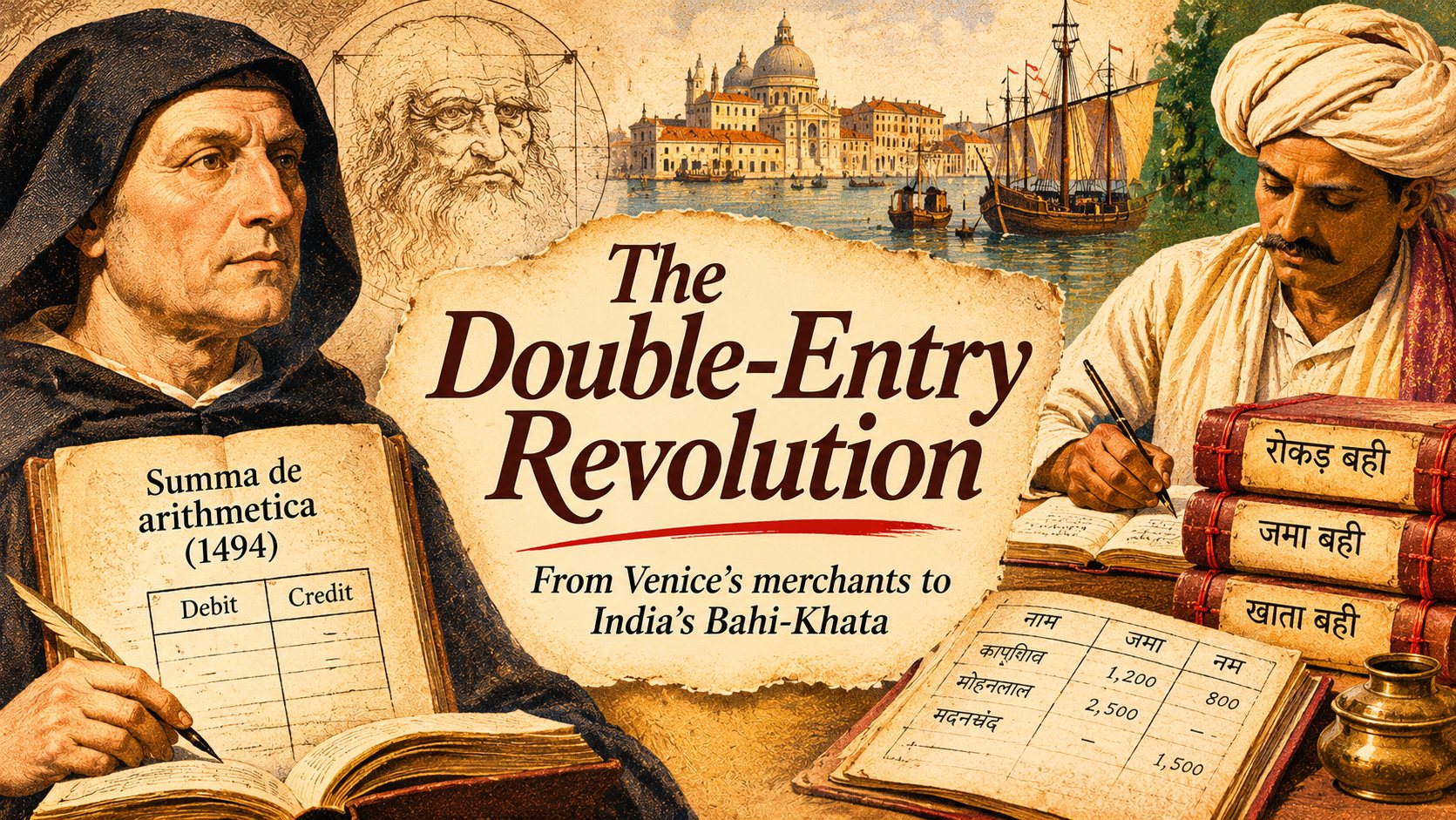
In 1202, Leonardo da Pisa, better known as Fibonacci, wrote Liber Abaci, introducing European merchants to the practical applications of Hindu-Arabic numerals in calculating interest, converting currencies and determining commercial profits. The gradual adoption of these numerals made commercial arithmetic considerably easier than it had been with Roman numerals.
Among the earliest surviving records of double-entry bookkeeping are the accounts of Florentine merchants dating to 1296 and the municipal accounts of Genoa from 1340.
In 1494, Luca Pacioli, an Italian Franciscan friar and mathematician, published Summa de arithmetica, geometria, proportioni et proportionalita in Venice. A section of the book explained the bookkeeping methods practised by Venetian merchants. Pacioli, who subsequently taught mathematics to Leonardo da Vinci, came to be known as the ‘father of accounting’.
In India, merchants and indigenous bankers maintained their accounts using a system popularly known as Bahi-Khata, or the Mahajani system. A trader typically maintained a Rokar Bahi (cash book), a Nakal Bahi (journal) and a Khata Bahi (ledger). Larger establishments also maintained separate books for hundi transactions.
Unlike conventional Western accounting, the credit entries (Jama) appeared on the left side of the cash book and debit entries (Nam) on the right. Accounts were balanced daily, with transactions subsequently posted to individual customer ledgers.
In September 1986, B.M. Lall Nigam, a professor at the Delhi School of Economics, published a paper in the accounting journal Abacus, arguing that the Indian Bahi-Khata predated Pacioli and may have reached Italy through Indian merchants. The hypothesis was challenged a year later by British accounting historian Christopher Nobes, who questioned the adequacy of the historical evidence.
The precise origins of the Indian system remain uncertain. However, the tradition of opening new account books during Diwali, accompanied by the worship of Lakshmi and Ganesha, continues among several Indian trading communities.