1 min to read
Discovering X-rays
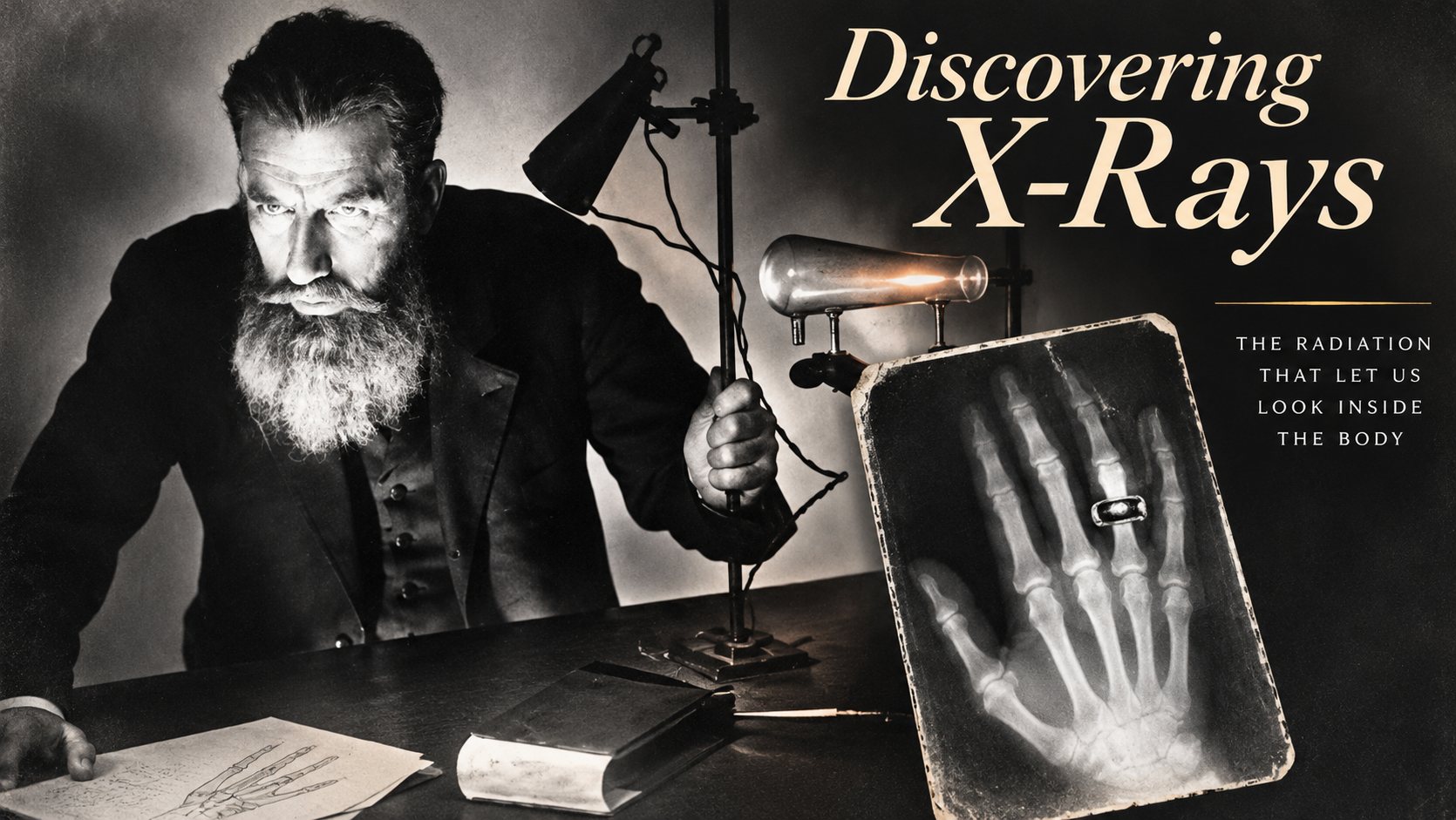
During the latter half of the nineteenth century, British physicist William Crookes experimented with the passage of electricity through glass tubes containing gases at very low pressure. The apparatus, subsequently known as the Crookes tube, became an important instrument in the study of cathode rays. Crookes also noticed that photographic plates kept near his experimental apparatus sometimes became fogged, although he did not establish the cause.
On 8 November 1895, Wilhelm Conrad Röntgen, a German physicist working at the University of Würzburg, was conducting similar experiments when he noticed something unusual. Although his discharge tube was covered with black cardboard, a nearby screen coated with barium platinocyanide began to glow whenever electricity passed through the tube.
Röntgen discovered that the radiation could penetrate paper, wood and several other materials opaque to ordinary light. Uncertain about its nature, he called it X-rays, using the mathematical symbol for an unknown quantity.
On 22 December 1895, Röntgen produced an X-ray photograph of the left hand of his wife, Anna Bertha. The image clearly showed the bones of her fingers and her wedding ring. Bones absorbed more radiation than the surrounding soft tissues, making them distinguishable on a photographic plate.
Within months of the discovery, hospitals began experimenting with X-rays to locate fractures, bullets and other foreign objects inside the human body.
Nikola Tesla was among the early investigators who documented the harmful biological effects of prolonged exposure to X-rays. The enthusiasm surrounding the discovery had initially led many researchers and medical practitioners to underestimate these dangers.
In 1901, Röntgen became the first recipient of the Nobel Prize in Physics. He donated the prize money to the University of Würzburg and chose not to patent his discovery, allowing researchers and manufacturers across the world to develop their own X-ray equipment.