1 min to read
The making of Nirma
In 1966, while awaiting his final-year college results, Karsanbhai Patel received an offer from New Cotton Mills in Ahmedabad to work as a chemist in its laboratory. Three years later, he joined the Gujarat government’s Department of Geology and Mining as a senior chemist.
Patel spent his spare time experimenting with synthetic detergents in the backyard of his house. He packed the detergent powder in small polythene bags and sold them to households, often cycling from door to door on his way to work. He named the product Nirma, after his daughter Nirupama.
In those days, synthetic detergents were largely considered a product for affluent Indian households. Hindustan Lever’s Surf, introduced in India in 1959, was priced at around ₹13 per kilogram, while Patel sold his detergent for ₹3.50. He also offered customers a money-back guarantee if they were dissatisfied with the product.
As demand grew, Patel gave up his government job and devoted himself to the detergent business. Nirma gradually developed a distribution network across the country, keeping its manufacturing and distribution costs low enough to cater to price-sensitive Indian households.
The growing popularity of Nirma forced Hindustan Lever to reconsider its own pricing and product strategy. In 1988, it introduced Wheel, a detergent aimed at the mass market.
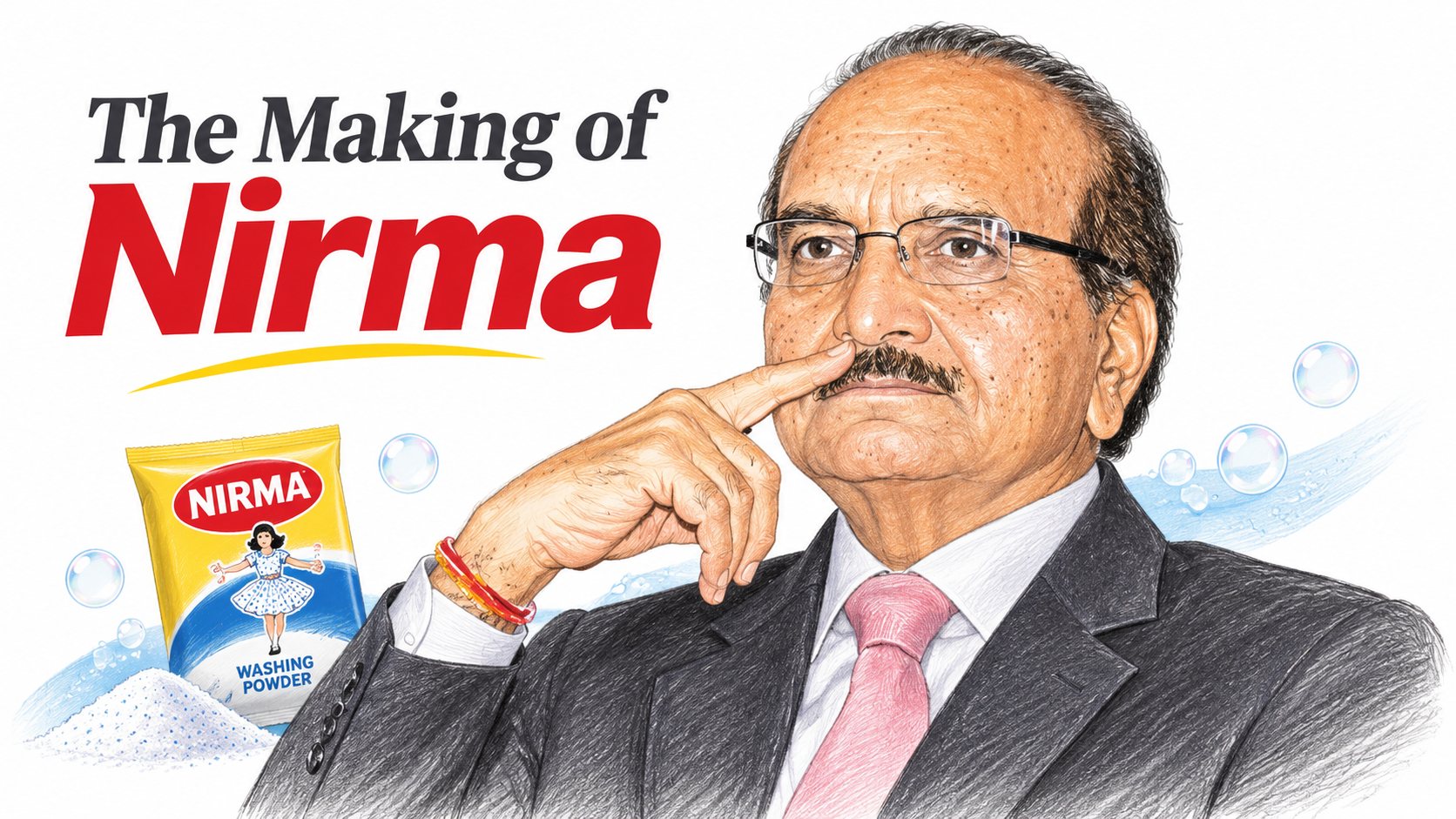
By then, Nirma’s television advertisement, featuring a little girl in a white dress and the familiar ‘Washing Powder Nirma’ jingle, had become part of Indian popular culture. The image of the girl also became the brand’s enduring visual identity.