1 min to read
Mayapuri: The Press That Gave Us Motu Patlu
From a Lahore calendar press to Lotpot, Chacha Chaudhary and the film magazine that renamed a Delhi industrial area — the Bajaj family's publishing story.
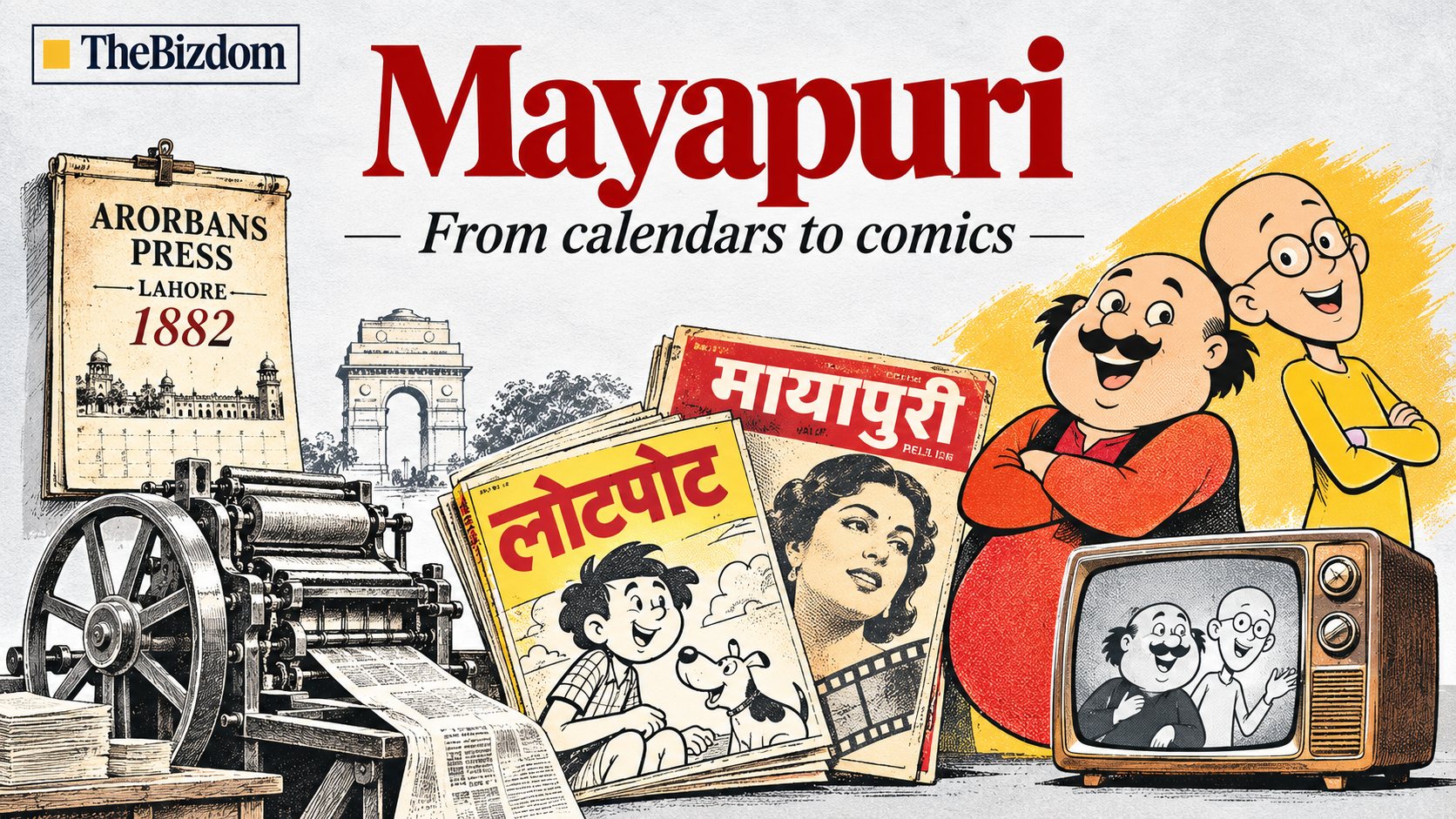
In 1882, S.L. Bajaj established Arorbans Press in Lahore, primarily engaged in printing calendars. Following Partition in 1947, the Bajaj family relocated its printing business to Delhi under the stewardship of Anand Prakash Bajaj. The family also diversified into poultry and dairy farming, acquiring two large tracts of land in what is now Gurugram in 1962.
In 1969, Bajaj ventured into children’s publishing with the launch of Lotpot, a Hindi humour and comic magazine. Among its contributors was a young cartoonist, Pran Kumar Sharma, who, incidentally, was also born near Lahore, in Kasur. Pran had begun his career in 1960 with the Delhi-based newspaper Milap. It was for Lotpot that he first sketched Chacha Chaudhary in 1969. In 1981, Pran began his long association with Gulshan Rai’s Diamond Comics.
Another popular creation associated with Lotpot was Motu Patlu, drawn by cartoonist Kripa Shankar Bhardwaj, who had earlier worked with the Hindi humour magazine Diwana.
In 1974, the Bajajs launched Mayapuri, a weekly Hindi film magazine. Among its notable contributors was the Lucknow-based satirist K.P. Saxena, who would much later write dialogues for films such as Lagaan, Swades and Jodhaa Akbar. Mayapuri found a readership well beyond individual subscribers, particularly through copies kept at barber shops across northern India.
In 1979, the family also entered paper manufacturing through Bajaj Paper Mills, setting up a paper recycling facility.
Under the third generation of the family, represented by Aman Bajaj, the group’s old comic characters found a new audience on television. On 16 October 2012, Nickelodeon began broadcasting a 3D animated adaptation of Motu Patlu, produced by filmmaker Ketan Mehta’s Maya Digital Studios. The series completed 1,000 episodes in September 2020.
There is also an interesting geographical connection to this business. According to the Bajaj family, the industrial locality in Delhi where they established their printing press was earlier known as Rewari Line Industrial Area. The popularity of their film magazine eventually gave the locality its present name, Mayapuri.