1 min to read
Before Michelin made tyres
In 1829, Édouard Daubrée married Elizabeth Pugh Barker, a Scottish woman believed to have been the niece of Charles Macintosh, the chemist whose experiments with rubber gave us the waterproof coat popularly known as the mackintosh.
The Daubrée family had made its fortune largely through the sugar trade, a business severely affected by the disruption of French maritime commerce during the Napoleonic Wars. In 1832, Édouard, along with his cousin Aristide Barbier, established a manufacturing business in Clermont-Ferrand, France. Among their early products were rubber balls, reportedly made with the help of Elizabeth’s knowledge of rubber processing.
The rubber industry was still in its infancy. In 1823, Macintosh had patented a process of dissolving rubber in naphtha and placing it between two layers of fabric to manufacture waterproof clothing. However, untreated rubber had its limitations, particularly its tendency to become sticky in hot weather and brittle in cold conditions.
In 1839, American inventor Charles Goodyear discovered that treating rubber with sulphur and heat considerably improved its properties, a process subsequently known as vulcanisation. Thomas Hancock secured a British patent for the process in 1843, a year before Goodyear obtained his American patent.
Goodyear subsequently challenged French manufacturers over their use of the process. Aristide Barbier, who had a legal background, helped defend the French rubber manufacturers in a dispute decided in their favour in 1854.
Barbier died in 1863 and Daubrée a year later. By then, another family had entered the picture through the marriage of Barbier’s younger daughter, Adèle, to Jules Michelin. Their two sons, André and Édouard Michelin, would eventually take charge of the family enterprise in 1889.
In 1891, the brothers patented a detachable pneumatic bicycle tyre, considerably reducing the time required to repair a puncture. That same year, cyclist Charles Terront won the Paris–Brest–Paris race using Michelin tyres.
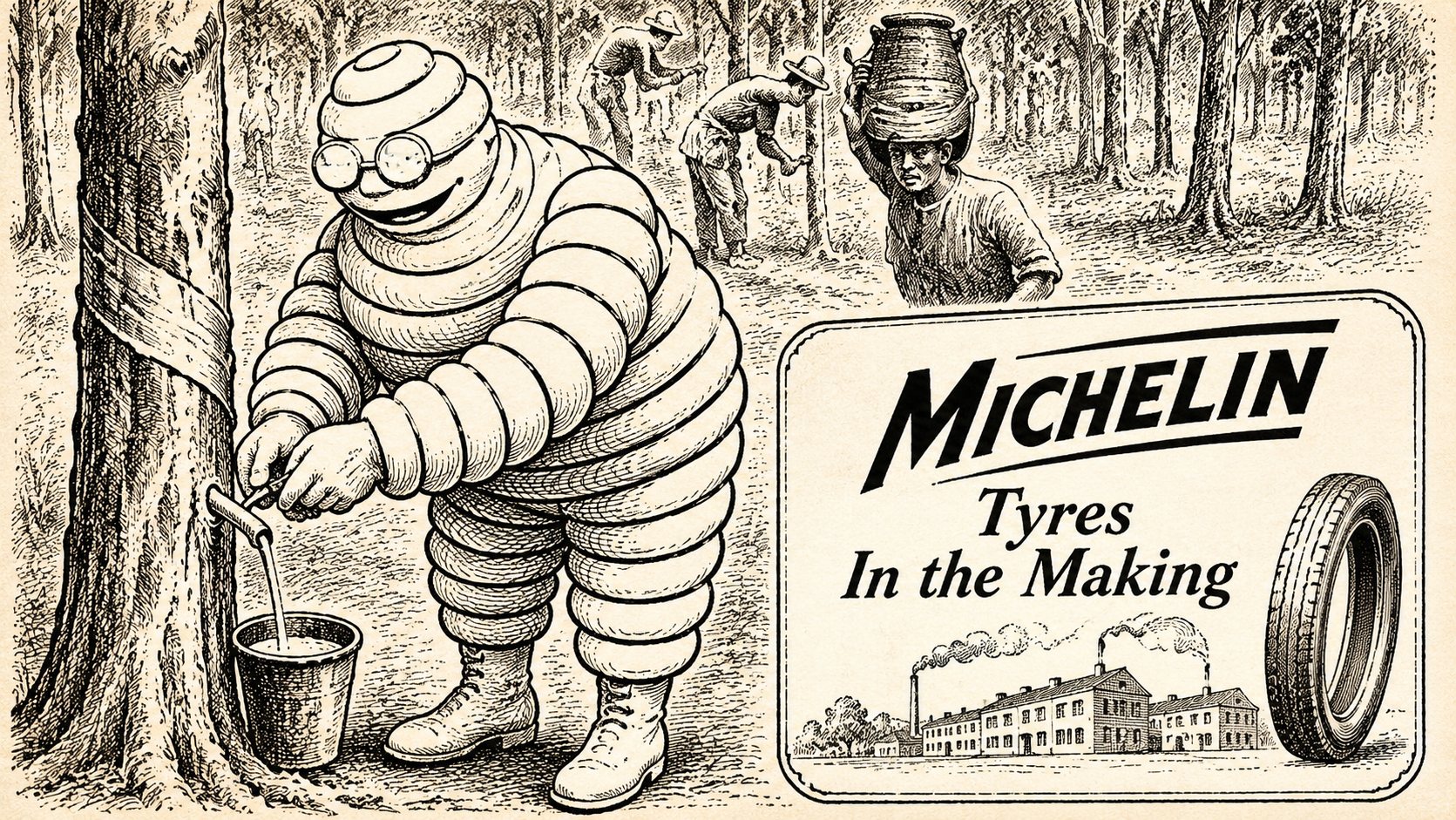
Seven years later, an advertisement featuring a rather unusual character assembled from a stack of tyres introduced the world to Bibendum, better known as the Michelin Man.
The origins of the French tire manufacturer thus had an unlikely connection with Scotland’s waterproof clothing industry.