2 min to read
Apeejay: From Jalandhar to Park Street
How a 20-year-old's steel unit in Jalandhar became the APJ group — shipping, Park Street's Park Hotel, Flurys, Oxford Bookstore and Britain's Typhoo tea.
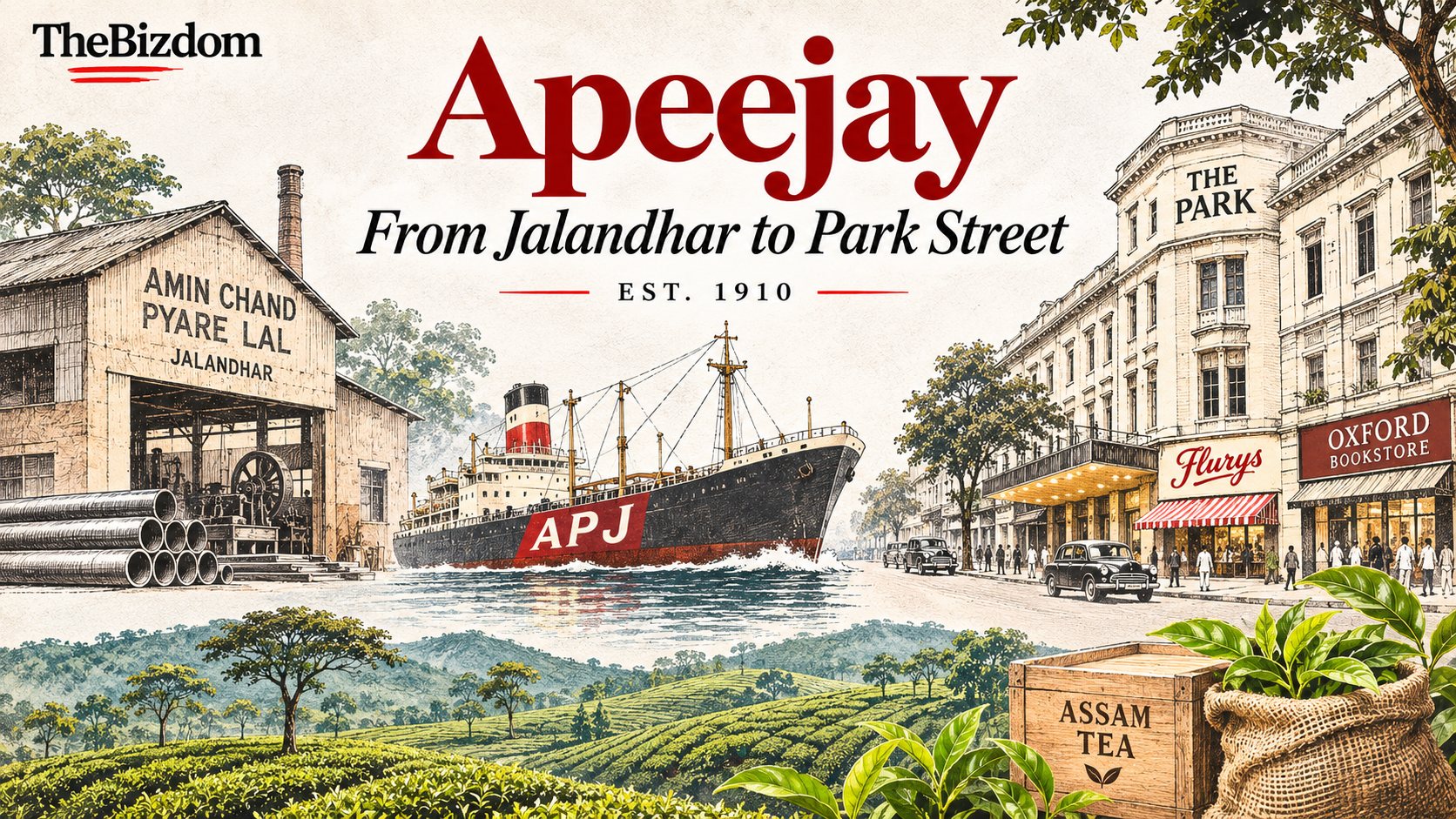
In 1910, a 20-year-old Pyare Lal set up a small unit in Jalandhar to manufacture steel goods for the agricultural market. The firm was named Amin Chand Pyare Lal, after his father and himself. The Second World War brought considerable demand for steel goods, and by 1947, the business employed 250 people.
Following Pyare Lal’s death in 1944, his four sons, Stya Paul, Jit Paul, Swraj Paul and Surrendra Paul, carried on the business. Their dependence on steel imports and the associated freight costs prompted them to enter shipping in 1948. The vessels subsequently carried the initials APJ in red and white: A for Amin Chand, P for Pyare Lal and J for Jalandhar. The phonetic rendering of APJ became the corporate name, Apeejay.
After shifting its headquarters to Calcutta in 1951, the group began importing steel from unconventional markets, including Czechoslovakia, Poland and the USSR. Its imports of railway rails from Eastern Europe provided an alternative to established Western European suppliers. In 1960, an Apeejay vessel became the first Indian ship to navigate the newly opened St. Lawrence Seaway connecting the Atlantic Ocean with the North American Great Lakes.
Much of Calcutta’s Park Street owes its commercial character to Jit Paul. The family acquired Flurys, the Swiss confectionery established in 1927, in 1965, opened The Park Hotel in 1967 and acquired Oxford Bookstore, originally established by the Primlani family in 1919, in 1987.
On 9 April 1990, Surrendra Paul, then chairman of Assam Frontier Tea Limited (subsequently renamed Apeejay Tea), was killed in Tinsukia district in an attack attributed to ULFA militants. His assassination created considerable anxiety among Assam’s tea plantation owners and managers, who were increasingly facing extortion demands from insurgent groups.
Following the division of the family business in 1989 and Surrendra Paul’s death the following year, his wife Shirin assumed the chairmanship. Surrendra’s name was added to Apeejay in his memory.
The group’s entry into tea plantations in Assam in 1980 eventually led to its acquisition of Britain’s Typhoo tea business from Premier Foods for £80 million in 2005. The Pauls sold their interest in the British business in 2021, sixteen years after acquiring the century-old tea brand.