1 min to read
The wall in Wall Street
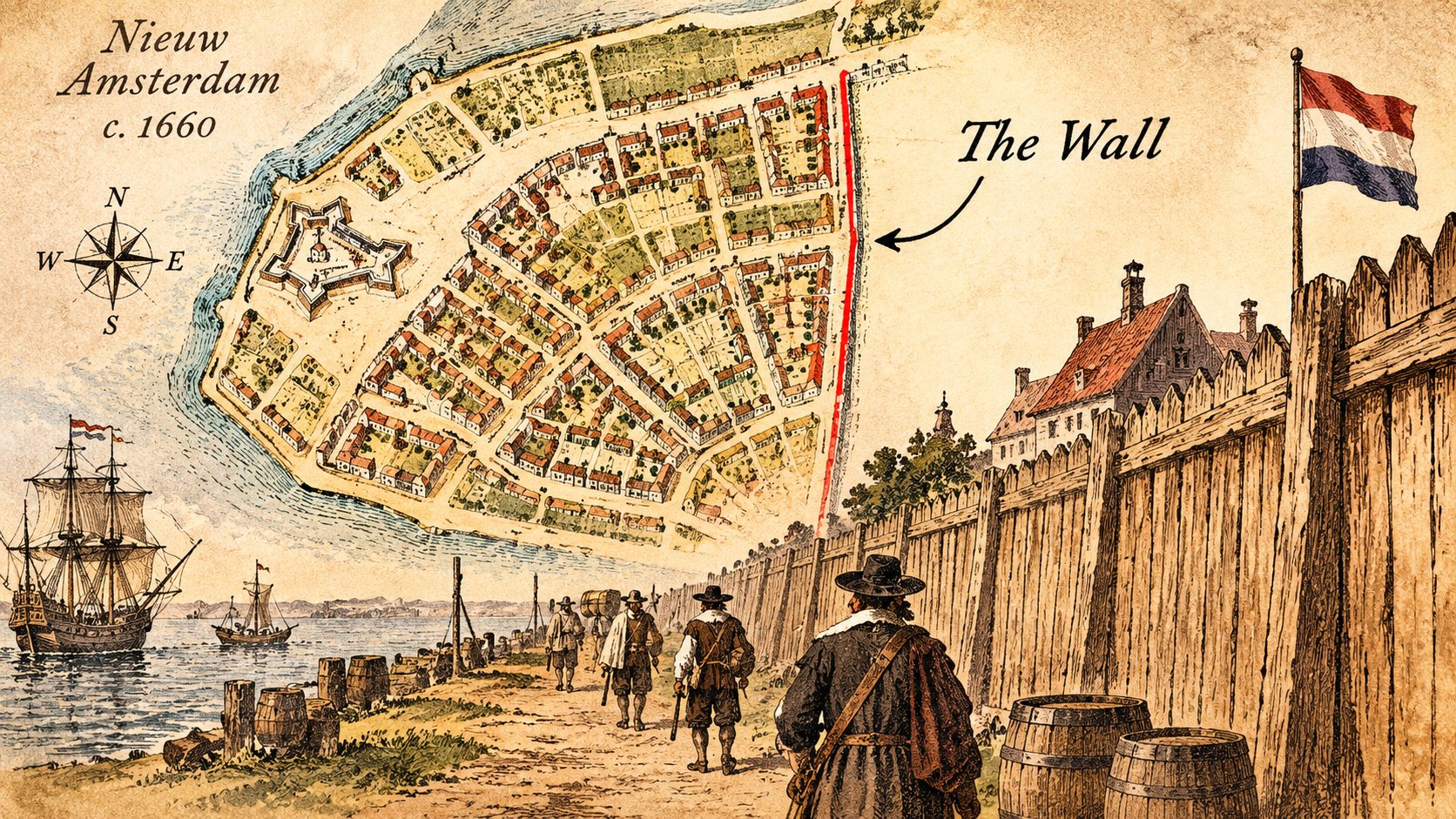
The Dutch began establishing settlements in what is now New York in 1624. The southern tip of Manhattan subsequently developed into a trading settlement called New Amsterdam, administered by the Dutch West India Company.
In 1653, during the First Anglo-Dutch War, Peter Stuyvesant, the Director-General of New Netherland, feared an attack by English forces based in neighbouring colonies. Since Fort Amsterdam could not accommodate all the inhabitants, the authorities decided to construct a defensive wall along the northern boundary of the settlement.
Built using wooden posts and earth, the wall extended approximately 2,340 feet and stood nine feet above the ground. Its construction cost the settlement around 5,000 guilders. The Castello Plan, a map of New Amsterdam dating to around 1660, provides a fairly detailed representation of the fortification.
In 1664, the English took control of New Amsterdam and renamed it New York, after the Duke of York. The wall gradually fell into disrepair and was demolished in 1699, although the street running alongside it retained its association with the old fortification.
Nearly a century later, on 17 May 1792, twenty-four stockbrokers and merchants signed the Buttonwood Agreement, named after the tree under which they reportedly conducted business. Among other things, the agreement stipulated a minimum brokerage commission of a quarter of one per cent.
The association subsequently developed into the New York Stock and Exchange Board in 1817, which was renamed the New York Stock Exchange in 1863.
The name of a seventeenth-century Dutch defensive structure thus entered the vocabulary of global finance.