6 min to read
The Chemist Who Took on the Multinationals
The story of Keki Gharda, a man who wanted to become a professor but ended up building one of India's leading chemical companies.
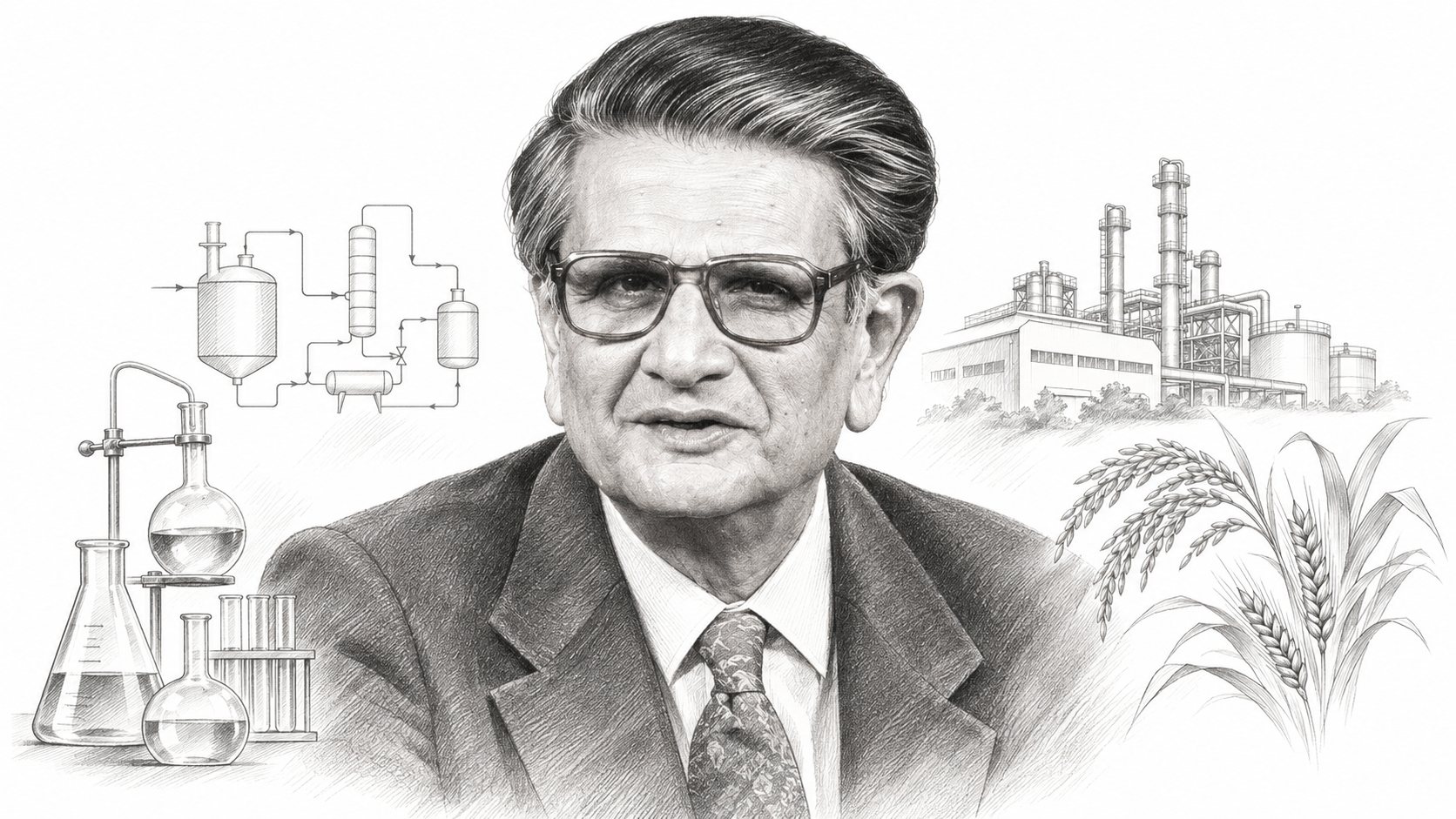
Sometime in the early 1980s, the Monopolies and Restrictive Trade Practices (MRTP) Commission was conducting a hearing on the grant of a manufacturing licence to a multinational company for isoproturon, a herbicide used primarily in wheat cultivation. A few Indian chemical manufacturers had opposed the application, fearing that they would find it difficult to compete with the multinational.
Among those invited to the hearing was Dr Keki Hormusji Gharda. He differed from both parties. He saw little reason why an Indian company could not develop a better manufacturing process. Gharda went a step further and committed himself to developing one within 18 months.
He did. By 1994, when Shivanand Kanavi wrote about him for Business India, Gharda had become the world’s second-largest producer of isoproturon. His manufacturing technology was internationally referred to as the ‘Indian process’, much to the discomfort of Rhône-Poulenc, the European chemical giant which had earlier dominated the market.
The Schoolgirl Blue
Born in Bombay in 1929, Gharda studied chemical technology at the University Department of Chemical Technology (UDCT), Bombay, before leaving for America to pursue his higher studies in chemical engineering. On his return to India, he taught at UDCT for some time, but could not secure a permanent position.
Many small chemical manufacturers in Bombay knew Gharda through his work and would occasionally approach him with requests to develop chemicals that were either unavailable in India or difficult to import.
One such product was phthalogen brilliant blue, a dye manufactured by Germany’s Bayer. It was popularly referred to as schoolgirl blue, owing to its use in school uniforms.
Gharda began experimenting with the dye in a rented shed of around 2,000 square feet at Vakola, near Santacruz. Electricity and water supplies were irregular, and his office furniture consisted of a drum and a large chemical container. With around ten workers and no other technically qualified person in the factory, Gharda looked after everything from procurement to production and sales.
He figured out that Bayer’s product was essentially a mixture of a dye and an agent that helped the colour bind to the fabric. By selling them separately, he could offer a dye with greater colouring strength per kilogram.
Within a few years, the economics of importing the German dye into India had changed considerably. Gharda was also competing with Bayer in its African markets. The product came to be known as Gharda Blue, and earned him his first P.C. Ray Award in 1970.
The partnership business had been converted into Gharda Chemicals Pvt. Ltd. in 1967, and manufacturing was subsequently shifted to Dombivli.
From dyes to agrochemicals
The 1960s and 1970s were interesting decades for the Indian chemical industry. Several Indian businessmen were setting up small manufacturing units to produce chemicals hitherto imported from Europe.
Four days ago, we covered the story of the Shroff family, The Making of an Agrochemical Giant from India, and how Rajju Shroff challenged the dominance of Swedish Match in the production of red phosphorus.
Incidentally, United Phosphorus entered the agrochemical business in 1976, around the same period when Gharda was looking to move beyond dyestuffs.
India had also introduced a new Patents Act in 1970. For a large category of chemical substances, the law recognised patents on the manufacturing process rather than the substance itself. An Indian company could thus manufacture a known chemical by developing a different, non-infringing process.
Much of the subsequent growth of the Indian pharmaceutical and agrochemical industries took place under this patent regime, which would undergo a major change in 2005.
For Gharda, the immediate reason for moving into agrochemicals was less academic. In the late 1970s, the government imposed an excise duty of 35% on dyes and intermediates. According to Gharda, manufacturers evading the duty could sell their products at prices he found difficult to match.
The company incurred losses and, in the course of a year, substantially changed its product portfolio. In 1980, it entered into a joint venture with the Gujarat government, Gujarat Insecticides Ltd., which would eventually become part of Gharda’s own business.
The business of chemical engineering
Discovering a chemical in a laboratory and manufacturing several thousand tonnes of it economically are two different branches of science. The selection of raw materials, energy requirements, recovery of solvents, management of waste and consistency of the final product determine how much it will actually cost to manufacture.
It was in this area of chemical engineering that Gharda had an advantage over several of his contemporaries.
The company went on to develop manufacturing technologies for a number of agrochemicals, including cypermethrin, anilophos and chlorpyrifos. Its research extended to the analytical instruments and methods required to determine chemical purity, an important consideration when supplying European customers.
Kanavi’s 1994 article mentions an interesting practice at Gharda Chemicals. Despite the financial difficulties of the early 1980s, the company had retained its research staff. Gharda also disliked the industry practice of compartmentalising production to prevent employees from learning the complete manufacturing process. He preferred having engineers who could collectively investigate problems in the factory.
In 1993–94, Gharda Chemicals had a turnover of Rs. 170 crore, including exports of Rs. 30 crore. Its profit before depreciation and tax stood at Rs. 45 crore.
Taking the battle overseas
In 1997, Gharda entered the American market with two products, chlorpyrifos and dicamba, associated with Dow and BASF respectively. Getting permission to sell these products in America was itself an expensive affair. Gharda paid around $5 million to each of the companies as compensation for the use of regulatory data.
There was also the question of convincing American customers about the reliability of an Indian chemical manufacturer. The existing suppliers offered incentives to distributors to retain their business.
In a 2007 interview with Sucheta Dalal and Debashis Basu, Gharda claimed that his company had secured nearly 20% of the American market for both products.
A rather curious development was reported by Business Today two years later. Dow, whose scientists had originally developed chlorpyrifos, was itself buying the insecticide from Gharda Chemicals.
Gharda had meanwhile extended his research into high-performance engineering plastics, including polymers that could withstand temperatures at which ordinary plastics would lose their useful properties. These had applications in specialised industrial equipment and aerospace components.
In 2004, the American Institute of Chemists conferred its Chemical Pioneer Award on Gharda. Incidentally, another Indian scientist, C.N.R. Rao, received the same award the following year.
Gharda at 91
As per a CRISIL report dated 18 June 2020, Gharda Chemicals was estimated to have recorded consolidated revenues of around Rs. 2,700 crore in FY2020, with an operating margin exceeding 26%. More than 60% of its sales came from overseas markets, reducing its dependence on the fortunes of the Indian monsoon.
Gharda, who has no children, has been directing considerable resources towards education, healthcare and scientific research.
In 2007, an engineering college was established by the Gharda Foundation at Lavel, near Khed in Maharashtra’s Ratnagiri district, not very far from the company’s chemical factory at Lote.
Among the courses offered at the Gharda Institute of Technology is, of course, chemical engineering. The man who once struggled to get a permanent teaching position in Bombay now has an engineering college of his own in the Konkan.