1 min to read
Rooh Afza: A Princess, a Newspaper and a Sharbat
A Unani hakim's 1907 summer remedy, an Urdu poem's heavenly princess, a Jaunpur weekly, and one label printed in Bombay that tied three nations to a rose-red sharbat.
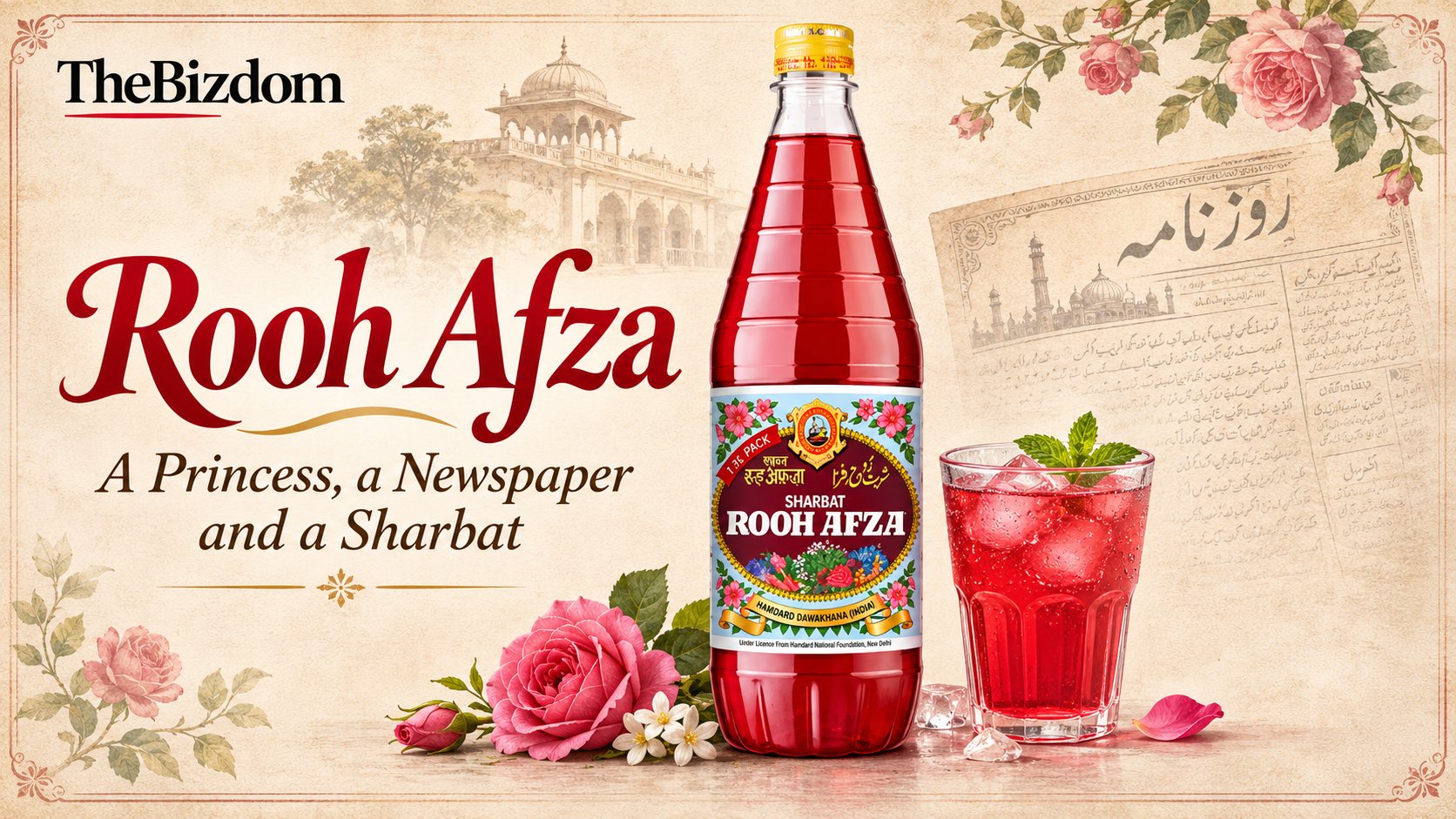
In 1906, Hakim Hafiz Abdul Majeed established Hamdard Dawakhana, a small Unani medicine establishment in Delhi. A year later, he developed Rooh Afza, a preparation intended to provide relief from the scorching summers of northern India.
Its original formulation made for rather interesting reading. Besides sugar syrup, it included pineapple, watermelon, coriander, carrot, spinach, mint, bottle gourd, chicory, white sandalwood, khus, kewra and Rosa damascena (Damask rose), among several other ingredients.
The origins of the name Rooh Afza, which roughly translates to ‘refresher of the soul’, remain uncertain. While some believe it was coined by Majeed himself, another possible source is Masnavi Gulzar-e-Nasim, a celebrated Urdu poetic work by Pandit Daya Shankar Nasim of Lucknow, published around 1254 Hijri (1838–39). One of its characters, Rooh Afza, was the daughter of Muzaffar Shah, the king of Firdaus (Heaven). Incidentally, Rooh Afza was also the name of a weekly publication brought out from Jaunpur in 1882.
In 1910, an artist named Mirza Noor Ahmad designed the colourful label for the sharbat. Since Delhi lacked the facilities to reproduce such a label, it was printed at the Parsi-owned Bolton Press in Bombay.
Following Partition, Majeed’s younger son, Hakim Mohammad Said, moved to Karachi in 1948 and established Hamdard there. In 1953, Hamdard Pakistan commenced operations in Dhaka, which subsequently became an independent entity following the creation of Bangladesh in 1971.
Rooh Afza thus became a rather unusual brand, manufactured by three separate Hamdard establishments in three different countries, all tracing their origins to the same Delhi dawakhana.